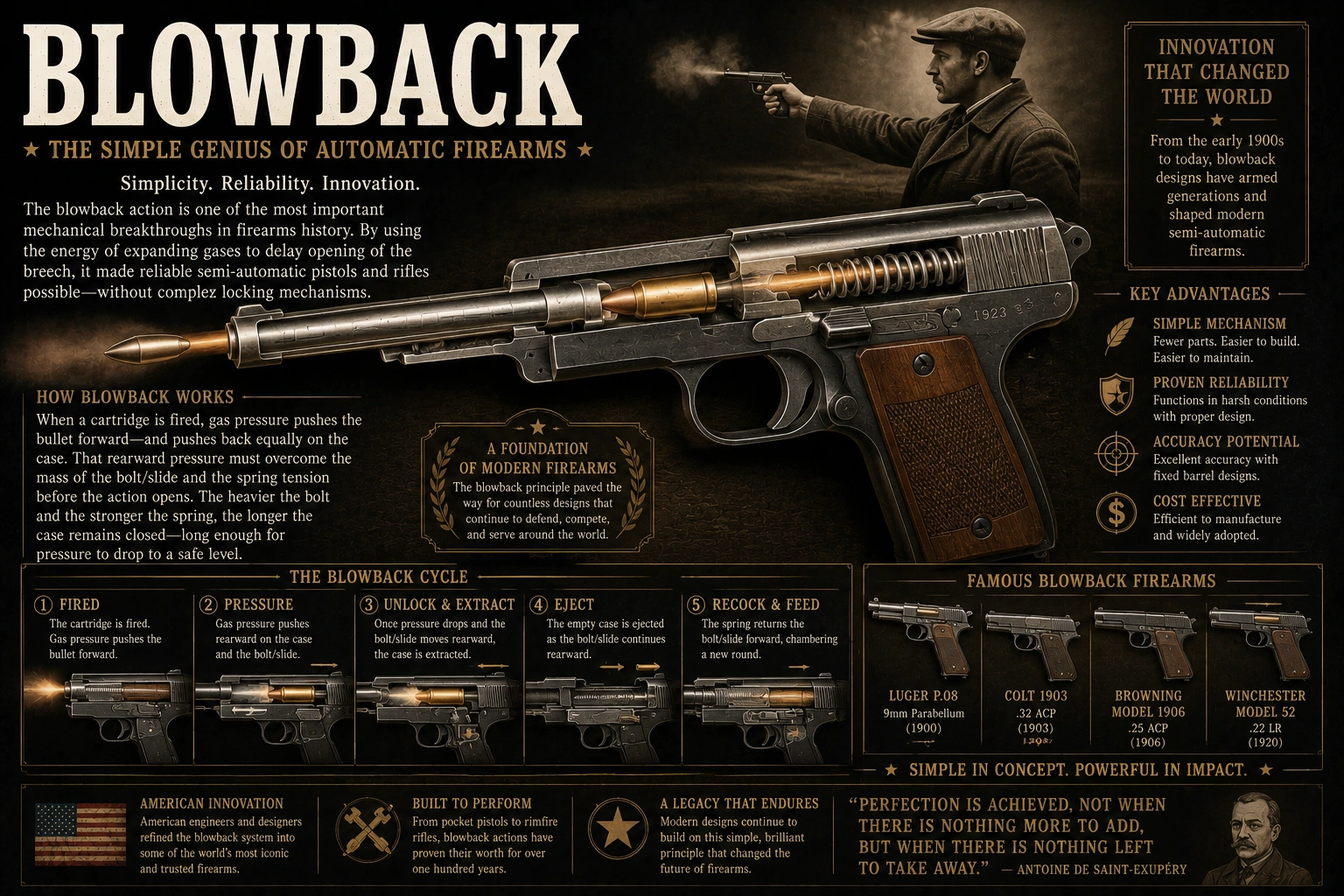
Blowback Firearms is part of the Gun Collectors Club American Firearms Encyclopedia. These entries connect mechanical design, historical use, production evolution, and collector evaluation into a single reference system.
This page is written as a practical collector reference: what the subject means, where it fits in firearms history, why it matters, and how it connects to other encyclopedia entries on the site.
When collectors understand the mechanism, the context, and the era, the firearm becomes more than an object — it becomes evidence.
What Blowback Means
Blowback operation is one of the simplest semi-automatic firearm systems. After firing, pressure pushes the cartridge case rearward against the bolt or slide. The mass of the moving part and the recoil spring delay opening long enough for the system to function safely.
This simplicity made blowback attractive for small pistols, rimfire arms, and lower-pressure cartridges.
Pocket Pistols, Rimfires, and Collector Examples
Many collectible pocket pistols and rimfire semi-automatics use blowback systems. Collectors encounter the concept when studying early Colt pocket pistols, Baby Browning-style pistols, .22 target pistols, and numerous European military and commercial handguns.
Blowback firearms can be elegant, reliable, and historically important, but their cartridge limits matter.
Blowback vs. Locked Breech
Higher-pressure cartridges usually require a locked-breech or delayed system rather than simple blowback. That is why a .22 LR target pistol can use simple blowback while many centerfire service pistols use locked-breech operation.
Understanding the difference helps collectors read design intent rather than merely cataloging a pistol by appearance.
Collector Perspective
Collectors should evaluate blowback firearms by condition, original magazines, grips, proof marks, manufacturer markings, and whether the recoil spring and slide show correct function. On many small pistols, original magazines can be a major value factor.
| Collector Question | Why It Matters |
|---|---|
| What cartridge is used? | Cartridge pressure often explains whether blowback operation was practical. |
| Is the magazine original? | Small blowback pistols often depend heavily on correct magazines. |
| Are markings clear? | Proofs, import marks, and manufacturer marks help establish origin. |
| Is the recoil system correct? | Weak springs, damaged slides, or altered parts can affect function and value. |
Encyclopedia Insight
Blowback is simple — but not primitive.
Some of the most collectible small pistols and rimfire target guns rely on blowback operation. The design’s genius is not complexity; it is using mass, spring tension, and cartridge pressure in the simplest practical way.
Related Encyclopedia Entries
Build Your Reference Shelf
Encyclopedia-style collecting works best with good books, careful photography, magnification, and a slow research process. I keep a curated list of reference books and collector tools for this kind of work.
Shop My LibraryAs an Amazon Associate I earn from qualifying purchases.

About Greg Cook
Greg Cook writes about firearms collecting, personal history, and the stories behind interesting guns. His Army MOS was 76Y, Unit Armorer, and he brings that practical background to his collector articles.