
The Colt Sauer .270 is one of the most refined sporting rifles ever sold under the Colt name. Built in Germany by J.P. Sauer and Sohn for Colt, it blended American brand identity with Sauer engineering, a non-rotating bolt body, deep blue finish, high-gloss walnut, and a level of fit that still separates these rifles from ordinary production hunting rifles.
Introduction
The collaboration between J.P. Sauer and Sohn, a venerable German firearms manufacturer, and Colt, an iconic American arms company, in the manufacture of bolt action rifles between 1973 and 1985, represents a fascinating chapter in the history of firearms.
This period was marked by significant innovations and shifts in the global firearms market, with both companies seeking to expand their influence and meet the evolving needs of gun enthusiasts. J.P. Sauer and Sohn brought their renowned craftsmanship and precision engineering to the partnership, while Colt contributed its vast market reach and brand prestige.
The bolt action rifles produced during this collaboration not only exemplified the merging of American and German firearm traditions but also left a lasting impact on the design and manufacture of rifles in the ensuing decades.
This essay delves into the historical context of this collaboration, examines the unique features and significance of the rifles produced, and explores the legacy they left in the world of firearms.
In the 1970s and early 1980s, Colt contracted with J.P. Sauer and Sohn to manufacture premium bolt-action sporting rifles for several key reasons.
Why Colt Partnered with J.P. Sauer and Sohn
Expanding Product Line
Colt, primarily known for its handguns and military firearms, wanted to expand its product line to include high-quality bolt action rifles. This expansion was part of a broader strategy to diversify its offerings and tap into different segments of the firearms market, particularly the sporting and hunting sectors.
Reputation for Quality and Craftsmanship
J.P. Sauer and Sohn had a long-standing reputation for exceptional craftsmanship and quality in gun manufacturing. Colt recognized that partnering with a company known for its high-quality bolt action rifles would ensure that the new product line met the standards expected by both Colt and its customers.
Technical Expertise and Innovation
J.P. Sauer and Sohn had specific technical expertise and experience in the design and manufacture of bolt action rifles. This expertise was crucial for Colt, which did not have a strong background in this particular type of firearm at the time. The collaboration allowed Colt to benefit from J.P. Sauer and Sohn's innovative designs and manufacturing techniques.
Market Demand and Competition
During this period, there was a significant demand in the U.S. for hunting and sporting rifles. Colt wanted to compete effectively in this market, and collaborating with an established European manufacturer allowed them to do so more quickly and effectively than if they had developed these types of firearms in-house.
Global Branding and Appeal
By partnering with a well-respected European gun maker, Colt could also leverage the global appeal and branding of J.P. Sauer and Sohn. This collaboration allowed them to attract customers who appreciated European design and craftsmanship in firearms.
Economic and Production Efficiencies
Collaborating with J.P. Sauer and Sohn may have also offered Colt certain economic and production efficiencies. By outsourcing the production of these rifles, Colt could avoid the significant investment and time required to set up and fine-tune its own production line for a new class of firearms.
Collector Insight
A Short, Distinct Colt Sporting-Rifle Chapter
In summary, the partnership between Colt and J.P. Sauer and Sohn was driven by strategic business decisions, aiming to leverage the strengths of both companies to produce high-quality bolt action rifles that met the demands of a diverse customer base in the sporting and hunting firearms market.
Production Years
The Colt Sauer Sporting Rifle is best understood as a short, premium, postwar production chapter rather than a pre-war or military pattern. There is no true pre-war Colt Sauer variation. Collectors normally discuss the model in terms of its early 1970s launch, its documented CR-prefix serial production, and the mid-1980s wind-down of Colt-branded Sauer rifles.
Research sources differ slightly because some references describe catalog introduction, some discuss European Sauer Model 80 production, and others focus on serialized Colt-branded rifles. For collector purposes, the safest summary is this: Sauer developed the smooth, non-rotating-bolt action around the Sauer Model 80, Colt-branded rifles reached the North American market in the early 1970s, documented CR-prefix production runs from March 1973 into July 1984, and the Colt-branded sporting-rifle line is commonly described as ending around 1985.
| Period | Collector Meaning | Notes |
|---|---|---|
| Early 1970s introduction context | Colt/Sauer sporting-rifle launch period | Some modern references describe the rifle as introduced before serial production data begins; collectors should separate catalog or market introduction from documented CR-prefix production. |
| March 1973 production start | Collector-reported CR-prefix beginning | Collector-source factory-historian data places the first serialed Colt Sauer rifles around CR1000. |
| 1973–1978 early CR-prefix production | Early Colt Sauer Sporting Rifle range | The original page noted the first 18,000 rifles in the CR-prefix range. Early guns are useful for dating and for comparing roll marks, magazines, and catalog features. |
| 1979–1984 later CR-prefix production | Later Colt-branded Sauer rifles | Collector-reported factory-historian data extends the CR serial span to CR28189, with July 1984 often cited as the documented end of serialized production. |
| 1981–1985 transition years | Sauer Model 80 to Sauer 90/92, while Colt-branded rifles wind down | European Sauer 90 and 92 rifles continued the action family after the Colt-branded run. They are related, but they are not Colt Sauer-marked rifles. |
Colt Sauer Variants and Chamberings
The Colt Sauer line was not just one .270 rifle. The .270 Winchester version shown here belongs to the medium-action family and used model number R8001. The broader Colt Sauer Sporting Rifle family included short, medium, magnum, and safari-length actions, with each caliber assigned its own model number.
| Action Family | Chamberings / Model Numbers | Collector Notes |
|---|---|---|
| Short action | .22-250 Rem. R8006; .243 Win. R8007; .308 Win. R8008 | The .22-250 is often cited as the scarce short-action chambering. Short-action receivers have limited roll-mark space, so collector photos should document receiver markings carefully. |
| Medium action | .25-06 Rem. R8000; .270 Win. R8001; .30-06 Sprg. R8002 | The .270 featured on this page sits in the classic American deer-rifle group. The .25-06 is generally treated as the more elusive medium-action chambering. |
| Magnum action | 7mm Rem. Mag. R8003; .300 Win. Mag. R8004; .300 Wby. Mag. R8009; .375 H&H R8010 | The .375 H&H is especially interesting because many collectors associate it with the “Grand Alaskan” idea, although standard receivers are typically marked Sporting Rifle rather than Grand Alaskan. |
| Safari magnum | .458 Win. Mag. R8005 | The .458 is the standout dangerous-game version and is roll-marked Grand African. It usually commands attention even when other Colt Sauer rifles are being overlooked. |
| Higher grades and adjacent Colt/Sauer long guns | Grade III / Grade IV engraved rifles; Colt/Sauer drillings R8015 and R8016 | Engraved high-grade rifles, original boxes, mounts, and correct magazines are collector-sensitive. The drillings are related Colt/Sauer long guns but should not be confused with the .270 Sporting Rifle. |
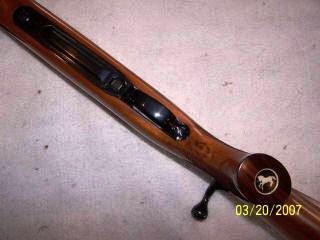
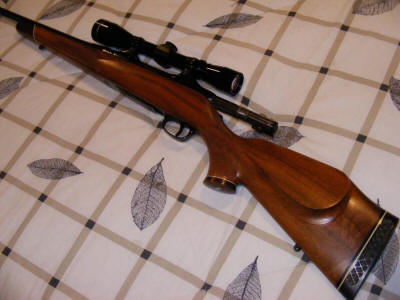
Typical visual features collectors document include deep blue metal, high-gloss walnut, rosewood fore-end and grip-cap treatment, skip-line or fine checkering, hooded front sight, barrel-mounted rear sight, ventilated recoil pad, and a detachable magazine with caliber-specific markings. Barrel length can vary by action and chambering. Current sold examples show .270 rifles listed with 24-inch or similar 23.5-inch barrels, while some later non-Colt Sauer 90 rifles used longer barrels.
Serial Number Ranges
Note the letters in the serial number. Colt Sauer rifles are generally associated with the CR serial-number prefix. The earlier version of this page focused on CR0001 through CR18000. Additional collector research points to a broader observed span of approximately CR1000 through CR28189, with production reported from March 1973 through July 1984.
| Range or Cluster | Collector Interpretation | Verification Notes |
|---|---|---|
| CR1000 | Collector-reported beginning of serialized Colt Sauer production | Often tied to March 1973 factory-historian data. |
| CR1000–CR18000 | Early production cluster | This is the range most often repeated in older collector notes and is the range the page previously emphasized. |
| CR18001–CR28189 | Later production cluster | Use Colt lookup, archive documentation, and physical features because public databases may be incomplete. |
| R8001 | .270 Winchester model number | Model number is not the serial number. It identifies the .270 chambering in the Colt Sauer family. |
| Post-1984 / 1985 inventory | End-of-line catalog and sales period | Rifles encountered as 1985 examples should be verified by serial lookup, archive letter, box label, or other paperwork. |
Collector Notes
Collectors are drawn to the Colt Sauer because it does not feel like an ordinary catalog hunting rifle. The rifle combines Colt branding, Sauer machining, a slick non-rotating bolt system, deep bluing, and European-influenced styling. That combination makes originality more important than cosmetic perfection.
- Fit and finish: Deep original bluing, crisp roll marks, clean stock finish, and intact rosewood accents are major value signals.
- Accuracy reputation: The rifles are widely respected for smooth operation and practical hunting accuracy. A clean bore and correct crown matter more than a polished exterior alone.
- Desirable chamberings: The .22-250, .25-06, .375 H&H, and .458 Grand African tend to receive the most scarcity attention. The .270 remains desirable because it is a classic medium-action sporting caliber.
- Correct magazine: Magazines are caliber and action-family sensitive. A missing, incorrect, or unmarked magazine should be reflected in value.
- Rare markings: Photograph the receiver roll mark, Sauer/Colt markings, caliber stamp, model number references, proof marks, and any engraved or high-grade features.
- Packaging and papers: Original boxes, manuals, hang tags, scope mounts, rings, and sales paperwork can materially improve collector confidence.
- No military/LE contract premium: The Colt Sauer was a premium sporting and hunting rifle, not a law-enforcement or military contract arm. Value comes from condition, caliber, originality, and documentation.
Known Issues and Inspection Points
The Colt Sauer is a high-quality rifle, but it is also a complex, discontinued rifle from a short production window. A serious buyer should inspect condition and originality before treating the rifle as a premium collectible.
- Parts availability: Colt Sauer-specific magazines, mounts, recoil pads, and small parts can be difficult to source. Missing accessories are more than cosmetic problems.
- Service limitations: Colt’s current service guidance says legacy models older than ten years generally are not serviced by Colt, with limited exceptions that do not cover this rifle line. A qualified gunsmith familiar with older sporting rifles is important.
- Action complexity: The non-rotating bolt and internally cammed locking-lug system are part of the appeal, but they are not as simple as a conventional Mauser-style action. Check bolt travel, safety function, feeding, extraction, and trigger behavior cautiously.
- Finish wear patterns: Look for high-gloss stock finish cracks, softened checkering, recoil-pad deterioration, sling-stud wear, muzzle wear, and scope-ring marks.
- Alterations: Rebarreling, rechambering, aftermarket recoil pads, drilled or nonstandard mounts, refinishing, or replaced magazines can lower collector value even when the rifle remains a fine shooter.
- Early vs. late features: Compare short-action roll marks, bolt vent holes, proof marks, model-number references, and magazine details to known examples before calling a rifle rare.
Value Trends
Colt Sauer values have remained firm because total production was limited, the rifles were expensive when new, and the best examples appeal to both Colt collectors and high-grade sporting-rifle collectors. Current 2026 sold-data snapshots show ordinary used Colt Sauer rifles commonly clustering in the low-to-mid $2,000 range, with individual results varying sharply by condition, chambering, accessories, and originality.
Recent market examples show why averages can mislead. Plain .270 and .30-06 rifles may trade below scarce-caliber examples, while Grade III/IV engraving, the .22-250, the .25-06, the .375 H&H, and the .458 Grand African can push substantially higher. A complete rifle with original box, papers, correct magazine, and clean wood usually deserves a stronger value discussion than a bare rifle with missing accessories.
Collector Takeaway
The Colt Sauer .270 remains interesting because it sits at the intersection of Colt branding, German sporting-rifle craftsmanship, limited production, and collector dating questions. The featured .270 R8001 is not the rarest chambering, but it is one of the best ways to appreciate the line: classic American hunting caliber, premium Sauer build quality, and enough serial-number nuance to reward careful documentation.
For a serious collection, the winning formula is simple: verify the CR-prefix serial number, confirm the rifle remains in its original chambering and configuration, document the magazine and markings, preserve the finish, and use factory or archive documentation whenever value depends on a specific year or special feature.

About Greg Cook
Greg Cook writes about firearms collecting, personal history, and the stories behind interesting guns. His Army MOS was 76Y, Unit Armorer, and he brings that practical background to his collector articles.
Related Reading
Research Sources Consulted
The added collector sections were checked against current and historical references, including collector serial-number notes, contemporary value data, and Colt’s own serial/archive guidance.