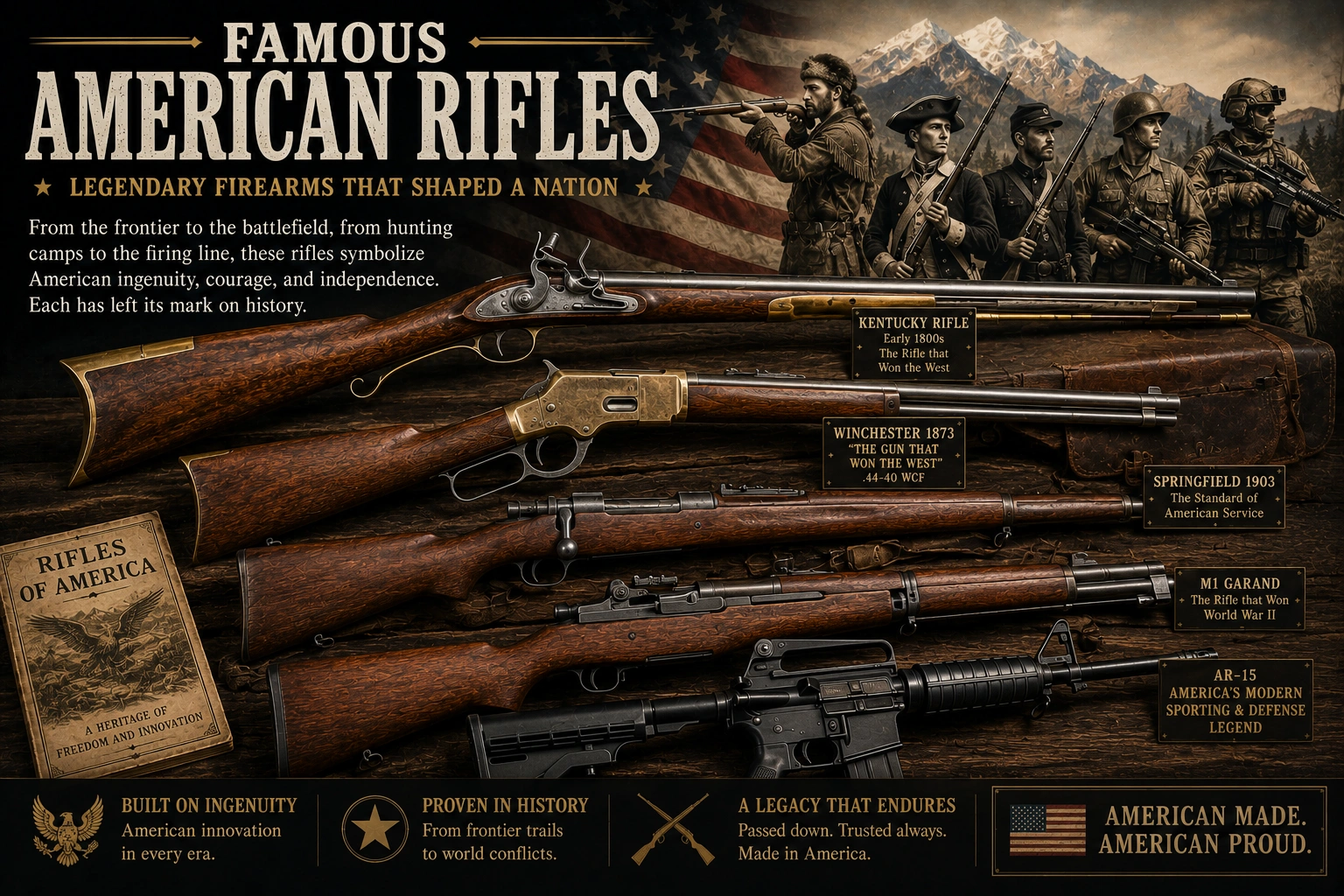
Famous American rifles – the M1 Garand and M16 series

A 1962 Colt Python, 1992 Colt Mustang and a 1968 Baby Browning.

Pictured: Remington Model 90-T Trap Gun


Among the weapons that use a gas-operating system, the M1 Garand somehow manages to stand out. The long-stroke gas piston is a particular characteristic of this 30 caliber rifle, one of the first semi-automatic firearms to be used by infantry forces. If in 1903 the Springfield rifle was the standard firearm used by the United States armed forces, thirty years later the M1 Garand successfully replaced it. It took almost another thirty years for the United States Rifle to be replaced with a new and improved model, the M14. However, the popularity of the M1 rifle maintained, it being purchased by a lot of people during 1960-1970.


History records demonstrate the M1 Garand was used extensively in the Second World War and also in the Korean War. At the same time, armed forces employed the rifle in the Vietnam War. American forces received the firearm with great enthusiasm and were impressed with its qualities. However, a large number of rifles were sold to other nations as well. When he came up with the design for the M1 rifle, John Garand was working for the Springfield Armory and was deeply interested in manufacturing a 30 caliber primer-operated breech. A competition began between Thompson, Garand and the original 1903 Springfield rifle. Springfield Armory also had to test Pedersen rifle, using the blowback operating system. Things were a little hectic for the American firearms industry, Garand winning finally the competition and entering mass production with his weapon.

It was in the summer of 1933 that the semi-automatic rifle, with a 30 caliber was finally ready. They were distributed to various army units for testing, including to infantry and cavalry forces. As there were a great number of things to be resolved, the M1 Garand went back for improvements and the first successful model was released in the summer of 1937. It was gas-operated and it had an incredible accuracy. As for the barrel and the gas cylinder, these were both redesigned and implemented on the new units. In just a couple of years, Springfield Armory produced an incredible number of 600 rifles per day, succeeding to satisfy all of the Army’s needs.


In order to win in battle, the United States knew they had to have an advantage over other countries. The M1 Garand rifle represented the exact help they were in so desperate need of, providing them with incredible firepower and accurate response, destroying enemy forces. Both German and Japanese forces were equipped at that time with bolt-action rifles, not having the capacity to deal with the M1 rifle. Today, the United States rifle remains extremely popular amongst gun enthusiasts and collectors from all over the world. The weapon was also a personal favorite of General George S. Patton.


During the Korean War, the demand for Garand’s rifles increased and there were many manufactures eager to produce them. The orders were taken over by important names in the American firearm manufacturing industry, such as Harrington & Richardson, Berretta and the new Springfield Armory. In modern times, the M1 rifle was especially adapted to be used by civilians, being chambered for both the 30-06 Springfield and also for the 308 Winchester cartridges. As for the warfare period, the M1 rifles were widely used, making other nations to develop their own firearms. After the war, countries likes Germany, Italy and Japan showed their particular interest for the M1 Garand rifle. And as incredible as it may seem, the Garand Rifle is still being in use today especially by the US Marine Corps and other law enforcement agencies.

The United States Rifle was designed to use a gas-operated system, being semi-automatic and utilizing clips for ammunition. At the moment of the original production, Garand intended his firearm to be used with the 276 Pedersen cartridges; however the following models to be produced were adapted for the 30-06 Springfield cartridge. These models had a fire range of almost half a km, being highly effective when it came to the wounding potential. It was said that the ammunition used was capable of piercing through someone’s armory at a distance of almost 800 meters. The original firing system used by Garand for his first model is today considered outdated and there are only few existing models out there. Throughout the years, the system was constantly improved, increasing the overall efficiency of the weapon.

The main characteristics of the M1 Garand rifle were represented by the following:


• Weight of almost 5 kg or 10 lb (unloaded);
• Length of 43 inches;
• Clip mechanism for ammunition – 30-06 Springfield;
• Rapid firepower;
• Stainless steel gas cylinder – innovation introduced to prevent deterioration;
• Simple assemblage and dismantling;
• Eight cartridges clip;
• Forward-looking trigger guard.

Apart from the many characteristics that could be observed at the M1 Garand rifle, there were just as many accessories produced at that time. Diverse bayonets, grenade launchers and rifle slings represent just few examples, not to mention the more-than-famous winter trigger, especially developed during the Korean War. The minuscule mechanism allowed for the easy operation of the trigger guard during extreme temperatures, when soldiers wore gloves and they could not move properly.

The history of the American firearms was not solely influenced by the developing of the M1 Rifle by John Garand. Another rifle standing under the United States trademark was the M16, especially chambered for a 5.56 mm caliber. It was developed by Colt, somewhere around the half of the 20th century and widely adopted by the military forces. There are many models included in the M16 family, all of them being at some time used by the infantry forces and the United States military in general. They also have been adopted in 15 NATO member countries, being more than popular.

What are the primary characteristics of the M16 rifle? Well, it is chambered as it was already said for a 5.56 mm caliber, it is incredibly light to carry and operates an air-cooling mechanism to prevent overheating. As for the basic action of the firearm, this is actually gas operated, the rifle being fed ammunition through a magazine. The gas-operated system is by direct impingement and a wide variety of materials are being used for the creation of one of the most popular firearms ever (steel, aluminum and even synthetic materials such as plastic).

Originally manufactured by Colt, today’s M16 series are produced all over the world and its semi-automatic versions are currently regarded with great favor. The firearm was adopted by the United States Aircraft somewhere around 1960s and since then it was used heavily by the US Marine Corps and various other military forces. Adopted also by NATO and the United States Navy, the fully-automatic version was incredibly well received and some are still being used today. NATO started to equip its forces with the M16 rifles in 1970s, causing other armies to be interested in similar weapons. The British, the Germans and even Belgians were interested in the technology used, trying to develop and improve their own M16-style firearms.

The M16 rifles were designed to be both practical and resisting. Manufacturers have been using the same materials for years, respecting the highest standards of quality: for the receiver, aluminum; for the barrel and the bolt steel; for the pistol grip semi-synthetic materials. The weapons have always maintained a reputation for being incredibly lightweight and the gas-operating system has always been regarded as innovative. From all the firearms ever manufactured and chambered for the 5.56 mm caliber, the M16 is the most popular. Today, there are 15 countries which are NATO members that use it and an additional number of 80 countries worldwide that believe in the undisputable qualities of this American firearm. An unbelievable number of 8 million units have been produced until the M16 rifle series were replaced with the latest rifle generation. It is incredible that these rifles are still being used, not only in the country of origin, but also in other places of the world, including Argentina, Bolivia, Canada, Costa Rica and even Denmark. Widely produced and used, the M16 rifles represent indeed important firearms, always ready to demonstrate the highest standards of quality and their incredible features!


 NEW! "Gun News" section of guncollectorsclub.com, where you can read about and comment on Gun News

Semi-Autos:  
1908 Colts: 24kt gold plated, fully engraved with mother of pearl. Colt Mustang: .380 caliber, baby 1911 - DOM 1992, real mop.
1908 Colts: 24kt gold plated, fully engraved with mother of pearl. 1908 Colts: 24kt gold plated, fully engraved with mother of pearl.
1911 Colt: For nine decades the Colt Government Model 1911 has been without challenge the most ... 1911 Colt: For nine decades the Colt Government Model 1911 has been without challenge the most ...
Colt Officer's Model: Slightly smaller than a Government Model, with the barrel length reduced from 5" to 3.5".
Browning .25 Caliber Automatic Pistol: The 1968 Gun Control Act stopped the importation of these guns.
Colt 1903 Pocket Hammerless .32: Produced from 1903 to 1945.
Colt 1908 Hammerless .25 (Vest Pocket) Model N was made in 1916.
Revolvers:  
Colt .32 Detective Special: Made in 1950, this gun is chambered in the .32 New Police cartridge (.32 S&W Long).
If you're interested in collecting Colt Single Action Army guns, click here for information that could make or save hundreds or thousands of dollars. Peacemaker: The Colt Single Action Army - this is a first generation gun.
Colt Python: Pythons produced from 1955 to 1969 have no letter in the serial number and are the most desirable to collectors.
Detective Special: One of the most well known and most copied guns in the world.
Colt Cobra: It was an earlier version of this gun Jack Ruby used to kill Lee Harvey Oswald.
Ruger .22 Single Six: Commonly referred to as a "Flat Gate".
Holsters:  
Gun Holsters and Various Methods of Carry: The holster is a very important part of "concealed carry".
Holster Gallery: Pictures of holsters that I have found to be of good quality as well as design, functional, easy to use and a good value.
Rifles:  
Colt Sauer Rifle: Bolt Action, 30.06 caliber, 24" bbl., magazine capacity 3 or 4 rounds.
Winchester .30-30: Lever Action, 30.30 caliber, saddle gun.
Shotguns:  
1908 Colts: 24kt gold plated, fully engraved with mother of pearl. Browning A-5: Auto 16 gauge short bbl, stamped U.S. Property.
Remington 90-T Trap Gun Remington Model 90-T: A Single-Shot 12 Gauge Trap gun with a 34" bbl, Full Fixed Choke, low vent rib and adjustable comb stock.
1908 Colts: 24kt gold plated, fully engraved with mother of pearl. Remington Pump: Pump action 12 gauge with stamped patent dates...
Abercrombie & Fitch: 12 Gauge, Single Shot, 32" bbl., full fixed choke, made by Renato Gamba for Abercrombie & Fitch about 1978.
Ads: