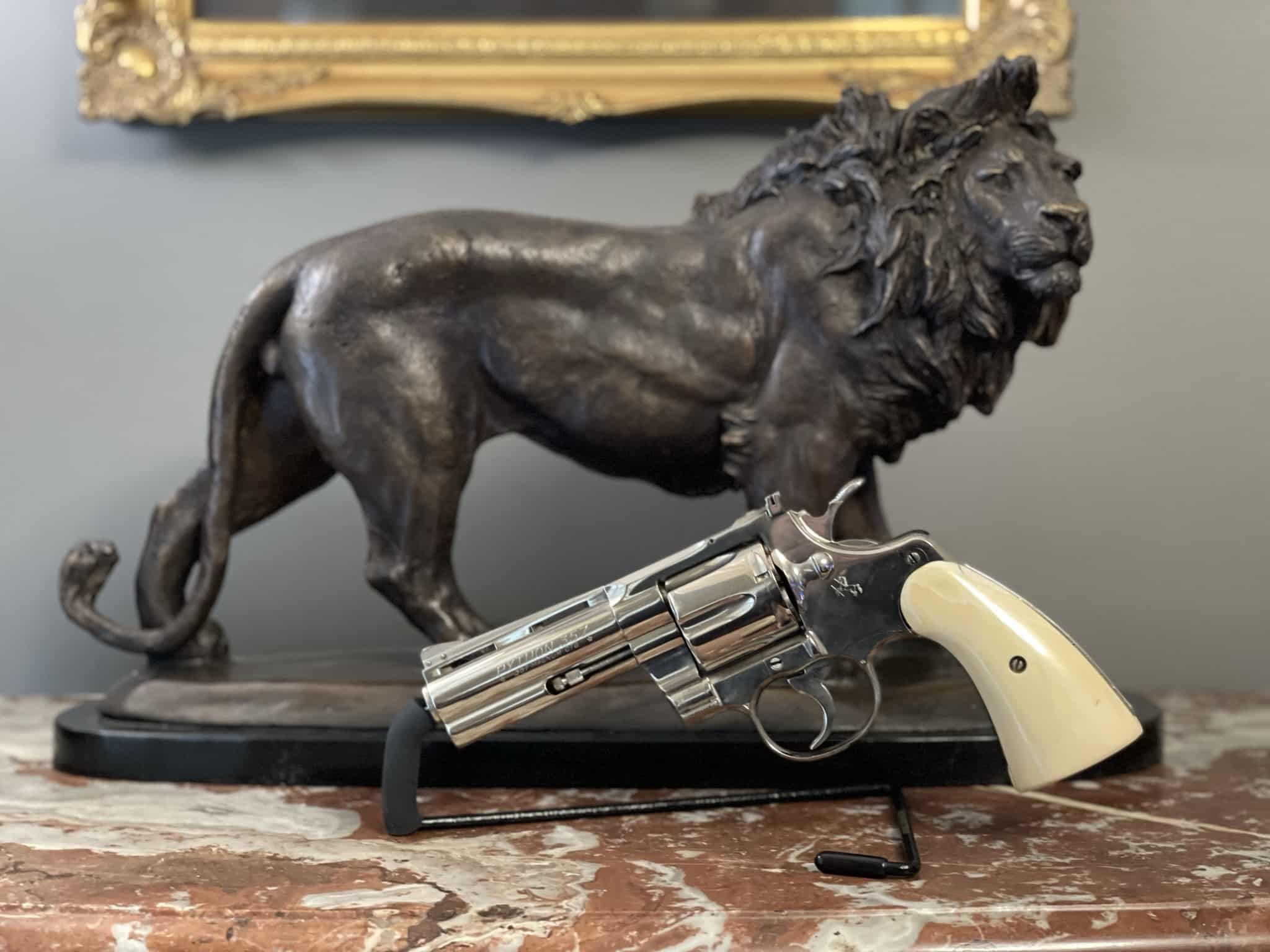
The Colt Python remains one of the most recognizable American revolvers ever produced, combining Colt’s famous Royal Blue finish, ventilated rib barrel, hand-fitted action, and target-grade accuracy into what many collectors consider the finest production double-action revolver of the twentieth century. Introduced in 1955 as Colt’s flagship .357 Magnum revolver, the Python quickly developed a reputation for exceptional polish, smooth trigger pull, and distinctive styling that still separates it from nearly every other revolver of its era.
Collectors today evaluate Colt Pythons using serial number ranges, barrel lengths, finish originality, grip styles, production-era features, and overall condition. Early no-letter serial number revolvers from the 1950s and early 1960s remain especially desirable, particularly examples retaining original Royal Blue finish, correct stocks, factory boxes, and Colt Archive documentation. Understanding production changes—including hollow underlug variations, serial-number prefixes, and finish evolution—helps collectors identify authentic examples and better understand current market values.
This Colt Python guide explores serial number tables, collector grading standards, finish variations, barrel length configurations, and production changes across multiple decades of Python manufacturing. Whether researching a family revolver, evaluating a purchase, or documenting a collection, these reference notes provide a solid collector-oriented starting point.
Why Colt Python Collectors Still Care
The Python sits at the intersection of factory craftsmanship, American revolver history, and modern collector demand. It was never just another .357 Magnum. Colt positioned it as a premium target revolver, and the combination of a ventilated rib, full underlug, adjustable sights, high-polish finish, and carefully tuned action gave it a distinctive identity. That identity is why a Python serial number search usually turns into a broader question about era, originality, finish, grips, and configuration.
When comparing examples, start with the serial number range, then verify the physical details against the production period. A no-letter 1960s gun should not be evaluated the same way as a late letter-prefix example or a modern 2020-production Python. Barrel length, factory finish, condition, provenance, and whether the revolver still carries correct stocks can all influence collector interest. Strong photographs and a clear written description are especially important for online research because many value questions depend on small visible details.
Colt Python Finish Guide
Original finish remains one of the most important factors in Colt Python desirability and collector value. Colt’s legendary Royal Blue finish became one of the defining visual characteristics of the Python line and still attracts collectors today.
- Royal Blue: The classic high-polish Colt finish most associated with early Pythons.
- Bright Nickel: Less common factory finish with strong collector appeal.
- Stainless Steel: Introduced later and popular among shooters and collectors alike.
- Ultimate Stainless: Highly polished stainless variation produced in limited quantities.
Colt Python Barrel Length Guide
Barrel length is one of the most important factors affecting Colt Python collector demand and pricing.
| Barrel Length | Collector Notes |
|---|---|
| 2.5 inch | Highly desirable concealed-carry configuration |
| 4 inch | Classic law-enforcement and duty size |
| 6 inch | Most iconic and commonly encountered collector length |
| 8 inch | Popular target and hunting configuration |
Collector Grading and Originality
Condition and originality remain critical when evaluating Colt Python values. Rebluing, altered sights, replacement grips, refinished metal, or timing problems can significantly reduce collector appeal and long-term value.
Collectors Commonly Examine
- Original finish quality and edge wear
- Timing and cylinder lockup
- Correct grips and Colt medallions
- Matching wear patterns across barrel, frame, and cylinder
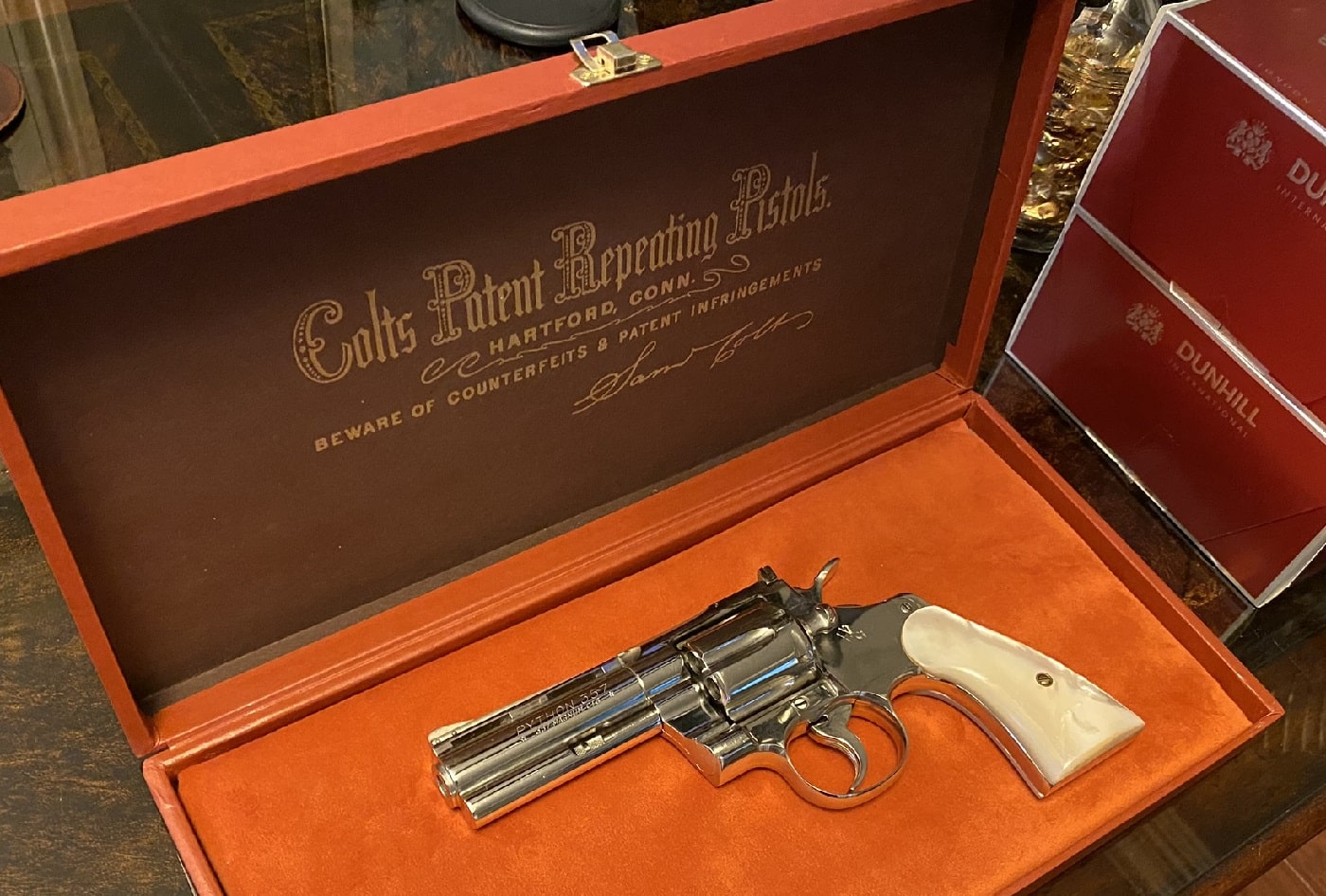
- Original box, paperwork, and accessories
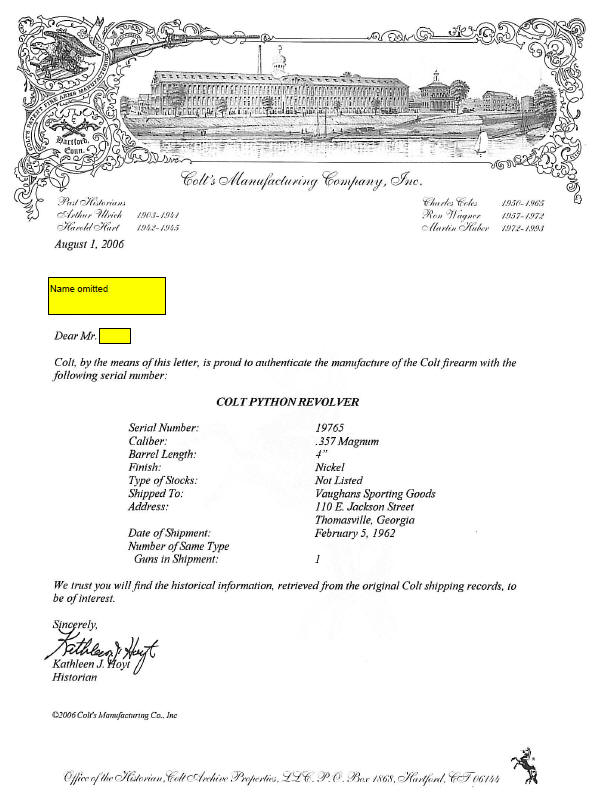
- Colt Archive Letters and documented provenance
The condition of an original Colt Python remains one of the largest factors affecting collector value. Before buying or selling a revolver, collectors should understand the grading standards outlined in our Firearm Condition and Value Guide. Maintaining detailed records and photographs can also help document originality and provenance over time.
Serious collectors often maintain a written inventory of serial numbers, purchase history, and supporting documentation. Our Gun Collection Inventory Guide explains how to create a useful collector record system.
1962 Colt Python and the Hollow Underlug
The underlug on these early guns was hollow until the 1964 production period. Some will describe the change to a solid underlug as an enhancement, but from a collector’s standpoint it also marks a visible production change. The production numbers increased sharply in 1964, making that year especially interesting when studying the transition.
Pre-1964 is gold to many Colt collectors, but condition, originality, and documentation still matter most.
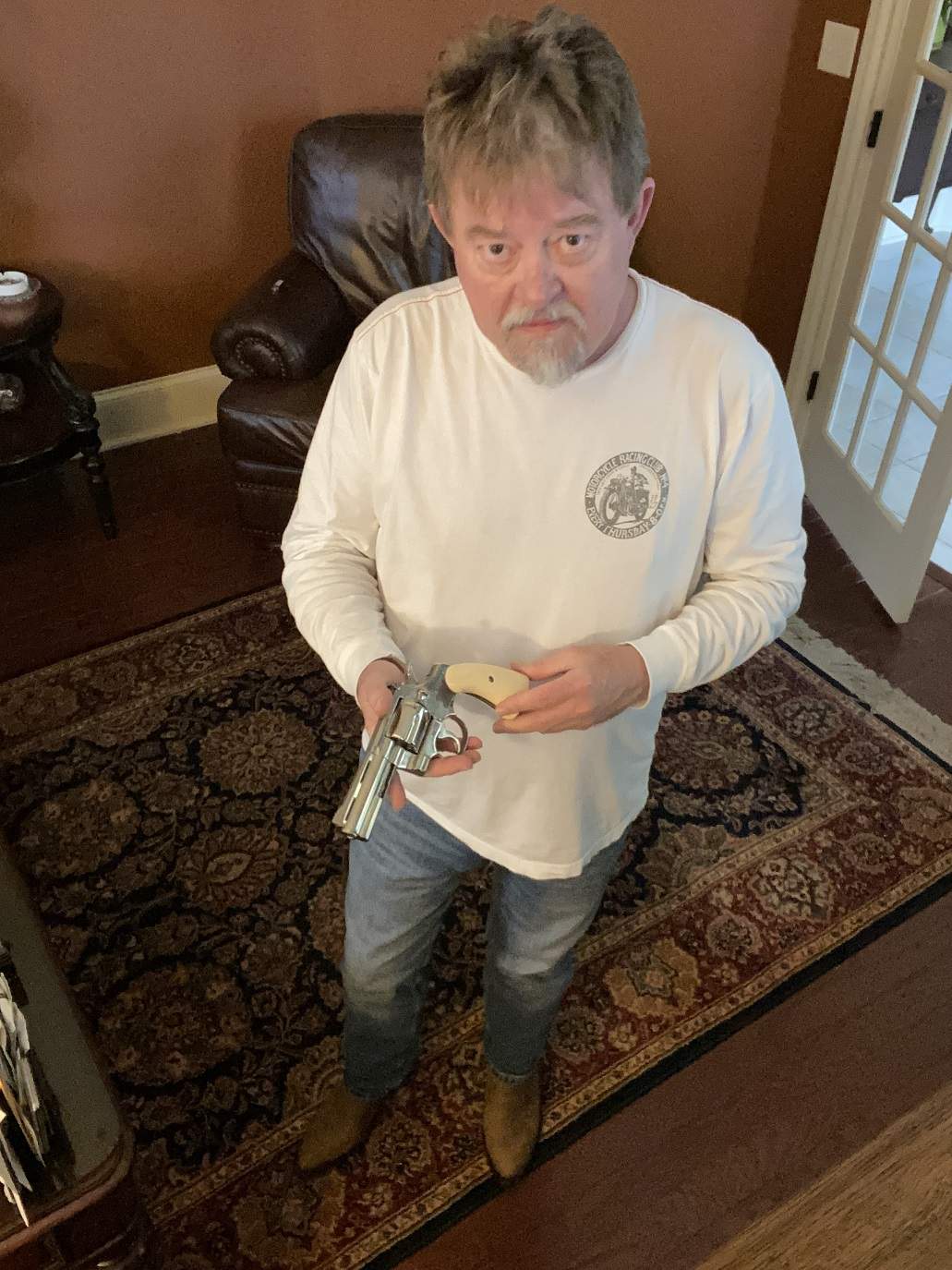
This 1962 Colt Python Is a Favorite
Pythons have a distinct appearance: a full barrel underlug, ventilated rib, adjustable sights, and Colt’s unmistakable polish and profile. Originally, Colt manufactured Pythons in Royal Blue and Bright Nickel. Later finishes included satin stainless and mirror-polished Ultimate Stainless models.
I enjoy swapping grips on this Python from time to time. It looks like a different gun with walnut grips versus ivory-style grips, and the action is smoother than any revolver I have handled. According to Colt, the Python was designed to shoot 2-inch groups at 15 yards, and this one still lives up to that reputation.
Production Changes and Collector Demand
Toward the end of 1969, the letter “E” was added as a prefix to the serial number. In 1975, the letter “E” moved to the end of the number as a suffix. In 1978 and later years, other letter combinations appeared.
Production appears to have peaked during the late 1970s and early 1980s, with 1981 standing out as a very high production year in the table below. The early no-letter years remain the classic collector period, but later Pythons have their own following depending on configuration and condition.
Colt Python Timeline for Collectors
The Colt Python timeline is useful because the revolver did not remain visually or mechanically static from 1955 through the end of regular production. Early guns are often judged by no-letter serial numbers, Royal Blue polish, hollow-underlug observations, correct stocks, and period-correct boxes. Later guns may show different serial-prefix patterns, finish options, and production-era details that place them in a different collector category.
For a deeper year-by-year breakdown, see the Colt Python Timeline, which follows the 1955 introduction, early hollow-underlug period, E/I frame refinements, Royal Blue evolution, grip and medallion changes, serial-prefix eras, Custom Shop years, discontinuation, and the 2020 modern revival. This page remains the working serial-number and identification reference, while the timeline page explains how the major production eras fit together.
| Era | Collector Significance |
|---|---|
| 1955 introduction | Beginning of the Python line and the earliest no-letter serial-number period. |
| Late 1950s to early 1960s | Classic Royal Blue, early production details, and highly watched collector examples. |
| 1964 production transition | Common reference point for underlug and production-volume discussions. |
| 1969 to late 1970s | Letter-prefix and suffix serial numbers become important identification clues. |
| 1980s to discontinuation | Higher production years, stainless variations, Custom Shop interest, and later collector categories. |
| 2020 revival | Modern Python production returns with important differences from the original hand-fitted guns. |
Colt Python Photo Reference
Photographs matter with Pythons because small details often separate an ordinary used revolver from a serious collector example. Finish wear at the muzzle, cylinder turn line, grip fit, medallion style, barrel address, sight configuration, and box or paperwork can all affect how the revolver should be described. The companion Colt Python photo gallery is a useful visual reference when comparing features before buying, documenting, or insuring a Python.
Colt Python Serial Number Tables
No Letter in Serial Number
The first 99,999 Pythons had no letter in the serial number.
| Year | Begin | End | Total |
|---|---|---|---|
| 1955 | 1 | 299 | 299 |
| 1956 | 300 | 1649 | 1,350 |
| 1957 | 1650 | 5549 | 3,900 |
| 1958 | 5550 | 7049 | 1,500 |
| 1959 | 7050 | 9099 | 2,050 |
| 1960 | 9100 | 13099 | 4,000 |
| 1961 | 13100 | 18799 | 5,700 |
| 1962 | 18800 | 24799 | 6,000 |
| 1963 | 24800 | 30799 | 6,000 |
| 1964 | 30800 | 41399 | 10,600 |
| 1965 | 41400 | 50499 | 9,100 |
| 1966 | 50500 | 60999 | 10,500 |
| 1967 | 61000 | 73799 | 12,800 |
| 1968 | 73800 | 89999 | 15,200 |
| 1969 | 90000 | 99999 | 10,000 |
Letter Prefix and Suffix Years
These production ranges include letters in the serial number.
| Year | Begin | End | Total |
|---|---|---|---|
| 1969 | E1001 | E6300 | 5,300 |
| 1970 | E6301 | E21200 | 14,900 |
| 1971 | E21201 | E38000 | 16,800 |
| 1972 | E38001 | E53500 | 15,500 |
| 1973 | E53501 | E61000 | 7,500 |
| 1974 | E61001 | E83700 | 22,700 |
| 1975 | E83701 | E99999 | 16,199 |
| 1975 | 01001E | 15000E | 14,000 |
| 1976 | 15001E | 48300E | 33,300 |
| 1977 | 48301E | 86200E | 37,900 |
| 1978 | 86201E | 99999E | 13,799 |
| 1978 | 01001N | ? | ? |
| 1978 | V01001 | V36736 | 35,736 |
| 1979 | V36737 | V88373 | 51,636 |
| 1980 | V88374 | V99999 | 11,625 |
| 1980 | AL01001 | AL9999 | 8,999 |
| 1980 | LA0101 | LA9999 | 9,899 |
| 1980 | VA1001 | VA9256 | 8,256 |
| 1980 | K01001 | K16265 | 15,265 |
| 1981 | K16266 | K75747 | 59,481 |
| 1982 | K75748 | K99999 | 24,251 |
| 1983 | T01001 | T27539 | 26,539 |
| 1984 | T27540 | T34452 | 16,912 |
| 1985 | T34453 | ? | ? |
Collector Takeaway
The Colt Python deserves its reputation, but the best collector pieces still come down to condition, originality, correct configuration, documentation, and the story attached to the individual revolver. Serial number tables are a starting point, not the final word.
View the 1962 Colt Python Photo Gallery
From My Bench
If you are setting up your own workspace or maintaining a collection, I keep a curated list of tools, books, cleaning gear, and bench items that fit the way I work.
Browse My Gear ListAs an Amazon Associate I earn from qualifying purchases. I only link to products, books, tools, and accessories that fit the editorial purpose of Gun Collectors Club.
Related Colt Python Pages

About Greg Cook
Greg Cook writes about firearms collecting, personal history, and the stories behind interesting guns. His Army MOS was 76Y, Unit Armorer, and he brings that practical background to his collector articles.