
The serial numbers of the pre-war NID/Knick Single-Barrel Trap Guns began with 400000 in 1922 and ended with serial number 402789 in 1942.
Research note: collectors often use “NID” and “Knick” together when describing these Ithaca single-barrel trap guns, but the factory serial-number references treat the Knick Single Barrel Trap as its own line, separate from the New Ithaca Double. This page focuses on the early, pre-war 400000–402789 serial range, which is the run that makes the “Only 2,790 made” note meaningful.
What Collectors Mean by “NID Knick”
The Ithaca gun on this page sits at an interesting overlap in collector language. “NID” stands for New Improved Design, a term most formally associated with Ithaca’s New Ithaca Double. “Knick,” however, is the name most often attached to Ithaca’s Frank Knickerbocker-designed single-barrel trap gun. In practical collector conversation, a 1920s Ithaca single-barrel trap gun like this one may be described as an NID-era Knick, a Knick Model, or simply an Ithaca 4E Single Barrel Trap.
That naming distinction matters because the single-barrel trap guns were not general-purpose field guns. They were purpose-built target guns. A field shotgun is judged by how it carries, points, and handles game; a trap gun is judged by whether it stays steady, shoots where the shooter looks, and crushes hard outgoing targets day after day. The Ithaca Knick was built for that second world.
The Trapshooting World That Created It
By the time Ithaca introduced the Knick in 1922, trapshooting was already a mature American shooting sport. Clay targets had replaced earlier live-bird traditions, automatic trap machines had changed the pace and consistency of the game, and the organized trapshooting world was moving toward the Amateur Trapshooting Association era. That timing helps explain the gun. A serious trap shooter in the 1920s wanted a specialized single barrel, a long sighting plane, a tight choke, a durable action, an ejector, and enough weight to tame recoil over long strings of targets.
The Knick belongs to that golden period when American makers still competed to build dedicated trap singles. Parker, L.C. Smith, Fox, Baker, and others all had their loyal followings, but Ithaca’s single-barrel trap line earned a reputation for staying power. The gun was not trying to be an all-around shotgun. It was a specialized instrument for one game, and that focus is exactly what makes surviving examples so interesting today.
From Flues to Knick
Ithaca’s first single-barrel trap guns were the earlier Flues models, named for designer Emil Flues. Those guns established Ithaca in the single-barrel trap market before the Knickerbocker design replaced them in 1922. Collectors commonly divide Ithaca single-barrel trap history into two early chapters: the Flues period and the Knick period. The gun featured here is from the second chapter.
The change from Flues to Knick was more than a new name. The Knick design is generally remembered for its strength, simplicity, and serviceability. It kept the elegant break-open profile collectors expect from a classic American trap gun while giving shooters a rugged target action intended for heavy use. That is why so many Knick guns still appear on collector tables, in trap-gun discussions, and occasionally at small local shoots where a shooter appreciates the feel of an older dedicated single.
Ithaca 4E, 1922–1942
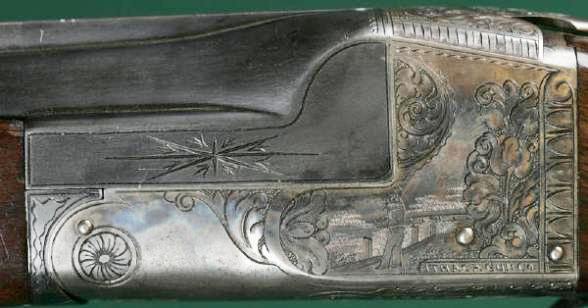
Ithaca 4E New Improved Design (NID) Knick (1927) - A Single-Shot 12 Gauge Trap gun with a 32" bbl, Extra-Full Fixed Choke, low vent rib, 13 3/4" Pull to Pachmayr pad, 2 3/8" drop, lightly figured walnut with pistol grip and beavertail fore-end, engraved receiver, Weight: 8lbs, 5oz. S/N: 4010xx. 90% blue, 30% case-colors, tight and excellent bore.
- ModelIthaca Knick Single Barrel Trap
- Grade4E engraved grade
- Year1927 by serial range
- Gauge12 gauge
- Barrel32 inch barrel
- ChokeExtra-full fixed choke
- RibLow ventilated rib
- Weight8 lbs., 5 oz.
Dating the Pre-War Serial Range
The 4010xx serial number on this example falls in the 1927 range. The table below follows the published Ithaca Knick Single Barrel Trap sequence for the pre-war run, using inclusive counts. These numbers are especially useful because a single digit can separate one production year from the next in the low-production 1930s.
| Year | Serial Range | Approx. Count |
|---|---|---|
| 1922 | 400000–400014 | 15 |
| 1923 | 400015–400055 | 41 |
| 1924 | 400056–400195 | 140 |
| 1925 | 400196–400473 | 278 |
| 1926 | 400474–400874 | 401 |
| 1927 | 400875–401181 | 307 |
| 1928 | 401182–401591 | 410 |
| 1929 | 401592–402006 | 415 |
| 1930 | 402007–402331 | 325 |
| 1931 | 402332–402464 | 133 |
| 1932 | 402465–402535 | 71 |
| 1933 | 402536–402551 | 16 |
| 1934 | 402552–402554 | 3 |
| 1935 | 402555–402586 | 32 |
| 1936 | 402587–402594 | 8 |
| 1937 | 402595–402632 | 38 |
| 1938 | 402633–402674 | 42 |
| 1939 | 402675–402706 | 32 |
| 1940 | 402707–402719 | 13 |
| 1941 | 402720–402747 | 28 |
| 1942 | 402748–402789 | 42 |
The total is 2,790 guns in the pre-war 1922–1942 sequence. That does not mean every later Knick is excluded from Ithaca history; it simply means this article is centered on the scarce pre-war run, the same run that includes the 1927 4E shown here.
Only 2,790 Made
Only 2,790 made!
Single-barrel trap guns are fun to collect and shoot, especially when they are nice as this beauty. I gifted this one to one of my sons-in-law when he showed an interest in shooting.
That low pre-war number is one of the reasons the Ithaca Knick feels different from many ordinary working shotguns. It was not a catalog filler. It was a specialized target gun bought by people who wanted a proper trap single. Many were used hard, restocked, refinished, had recoil pads changed, or were altered to fit a particular shooter. A clean example that still shows strong blue, remaining case colors, good engraving definition, tight lockup, and a bright bore deserves careful documentation.
Grades, Engraving, and the Place of the 4E
The Knick line appeared in several grades, including Victory, 4E, 5E, 7E, and the highly embellished Sousa Special. The 4E grade is especially appealing to many collectors because it offers visible engraving and better finish without moving into the very rare, high-art category of the top grades. A 4E can still look like a serious competition gun rather than a museum-only showpiece.
On Ithaca trap guns, engraving and condition work together. Sharp engraving with honest finish is more desirable than rounded, polished engraving under a later refinish. Case colors are also important because they are one of the first condition clues collectors notice when the gun is opened under good light. The receiver on this example is noted as having about 30% case colors, which is the kind of detail worth preserving in any future record of the gun.
The Sousa Special represents the opposite end of the collector spectrum. Named in honor of John Philip Sousa, the famous band leader and trapshooter, Sousa-grade Ithacas are known for elaborate gold inlays and special engraving motifs. They are useful context for this 4E because they show how seriously Ithaca treated its trap-gun line. The same family of guns could range from a practical target single to one of the most decorated American trap guns of its period.
Design Details That Matter to Collectors
A good Ithaca Single Barrel Trap inspection starts with the features that make it a trap gun. The 32-inch barrel gives the shooter a long sighting plane. The extra-full fixed choke reflects the trap-shooting purpose. The low rib, pistol grip, beavertail fore-end, and solid eight-pound-plus weight all fit the same idea: a gun meant to move smoothly, stay steady, and keep recoil manageable during repeated shooting.
The automatic ejector is another defining feature. On a trap line, the shooter fires one shell, opens the gun, and expects the empty to clear quickly. A clean, correctly timed ejector is not just a convenience; it is part of the rhythm of a single-barrel trap gun. When evaluating one today, the ejector, hinge, locking surfaces, firing pin, fore-end fit, rib, bore, and stock head all deserve a close look.
The Pachmayr pad noted on this gun is also worth recording. Trap guns were often fitted to their owners. A replacement recoil pad may make a gun more pleasant to shoot, but it can also change length of pull and collector originality. The right approach is not to ignore the pad, but to document it clearly: length of pull, pad brand, fit quality, and whether the stock appears to have been cut.
Video: Ithaca NID Single Barrel Trap
This short Vimeo clip is included as part of the page record so the shotgun has both written collector notes and a video reference in one place.
Turkey Shoots
The factory history is important, but the charm of a gun like this comes from more than a serial number. A single-barrel trap gun was made for competition, and local turkey shoots are one of the places where old target guns still earn attention from people who recognize purposeful design when they see it.
One of my favorite things to do in the Fall is go to Turkey Shoots. Here in the south a Turkey Shoot is an event where shooters compete for prizes by shooting at paper targets. My son-in-law and I carried this gun on several occasions and it performed very well.

I love the way the Trap Guns like this one break down and can be carried in a Leg-O-Mutton gun case. The smaller package is much easier to transport and decreases the likelihood that your gun will get bumped and dinged during the process of going and coming from those Turkey Shoots.
Photos and Use
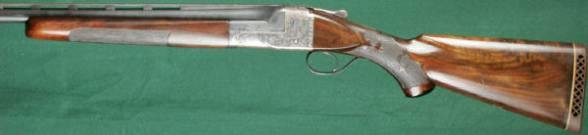
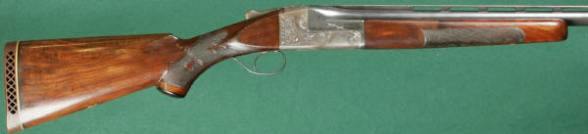
Old shotguns like this one are not only useful tools, they are truly a thing of beauty. The wood on this gun is absolutely pristine and the checkering really sets it off. The engraving on the receiver adds to the visual aesthetics as well.
When my son-in-law pulls this gun out of the case at the Turkey Shoot and begins to assemble it, all eyes are drawn to it just to see what it is. And I can tell you that the odds are 99 to 1 that it will always be the oldest gun on the range.
Collector Checklist for an Ithaca Knick SBT
When documenting an Ithaca Knick, the goal is to preserve the gun’s story in a way that will still make sense to another collector years from now. The notes below are the practical details I would want to see kept with this shotgun.
| Feature | Why It Matters |
|---|---|
| Serial number | Dates the gun and places it within the scarce pre-war 400000–402789 range. |
| Grade marking and engraving | Separates Victory, 4E, 5E, 7E, and higher-grade guns; sharp engraving supports originality. |
| Barrel length and rib | Trap guns often have long ribbed barrels; changes or replacement barrels affect collector value. |
| Choke | Full and extra-full chokes fit the trap purpose; record the measured constriction when possible. |
| Stock dimensions | Length of pull, drop, pad, and comb shape tell whether the gun was altered for a shooter. |
| Case colors and blue | Finish condition is a major visual and value factor on engraved target guns. |
| Ejector function | The automatic ejector is part of the Knick’s identity and should be inspected for timing and reliability. |
| Factory letter | Cody Firearms Records may confirm date, configuration, and sometimes original customer information. |
Preservation, Display, and Documentation
The best thing a collector can do for a gun like this is resist the urge to over-improve it. A bright refinish, heavy polishing, rounded screw slots, recut checkering, or an aggressively sanded stock can remove the very evidence that makes the gun interesting. Honest age is not a defect. On a 1927 4E, the remaining blue, surviving case colors, original engraving lines, wood fit, and even the old recoil pad all help tell the story.
For storage and display, keep the shotgun clean, dry, and supported. A proper gun stand helps when photographing details such as the rib, receiver flats, fore-end iron, and engraving. For maintenance, use a conservative approach to cleaning vintage firearms, especially around case-colored metal and old walnut. The goal is preservation, not restoration unless the gun truly needs professional work.
For research, a Cody factory letter is one of the most useful additions to the file. Ithaca records vary by period, and post-1939 records are not as complete as earlier ledgers, but a letter can still help confirm configuration details and sometimes original shipping information. For a pre-war Knick, that documentation can make the difference between a nice old trap gun and a well-supported collector example.
Collector Takeaway
The Ithaca NID Knick is a compact collector story: low production, visible engraving, classic walnut, and a practical shooting-life connection. For this example, the serial range, 32-inch barrel, extra-full fixed choke, low vent rib, and condition notes are the essential details to keep with the gun.
The Ithaca NID/Knick Single Barrel Trap remains one of the classic American dedicated trap guns worth preserving, not only for its field history but also for the craftsmanship that separates it from ordinary working shotguns. Whether displayed in a collector room, photographed on a proper gun stand, or maintained with careful attention to cleaning vintage firearms, this pre-war Ithaca rewards owners who treat condition and originality as part of its story. Collectors who appreciate well-built sporting arms may also enjoy comparing its American target-gun character with the later craftsmanship found in Miroku shotguns.

About Greg Cook
Greg Cook writes about firearms collecting, personal history, and the stories behind interesting guns. His Army MOS was 76Y, Unit Armorer, and he brings that practical background to his collector articles.
References and Sources
The sources below were consulted for serial-number ranges, factory-record availability, grade context, trapshooting background, and period catalog context. The personal notes, photos, and turkey-shoot memories on this page are from the author’s collection record.
- Ithaca Gun Co. Serial Numbers — factory serial-number tables for Ithaca models, including Flues and Knick single-barrel trap guns.
- Cody Firearms Records Office: Ithaca, Lefever & Western Arms Firearms Records — information on Ithaca factory letters and surviving record coverage.
- Cody Firearms Records: Available Serial Number Ranges — published PDF listing available Ithaca record ranges, including Knick Singles.
- Gun Digest: Ithaca Gun Co. Knick Model Single-Barrel Trap — model overview, designer attribution, ejector note, and grade list.
- Gray’s Sporting Journal: “Revisiting the King of Trap Guns” — historical context for Ithaca single-barrel trap guns and the Flues-to-Knick transition.
- Cornell Publications: Ithaca 1931 Gun Catalog — period catalog reprint listing Ithaca single-barrel trap guns, the No. 4 One Barrel Trap, the No. 7, and the Sousa Special.
- NRA National Firearms Museum: Ithaca 7E Single Barrel Trap Shotgun — museum notes on high-grade Ithaca single-barrel trap guns and Sousa-grade context.
- Amateur Trapshooting Association: Trapshooting Timeline — background on the development of American trapshooting, automatic traps, clay targets, and the ATA era.