
The Colt Single Action Army, also known as the Colt Peacemaker or Model P, is one of the iconic revolvers of American firearms history. Colt's Manufacturing Company introduced the model in 1873, and its frontier reputation helped give rise to the familiar phrase, “the gun that won the West.”
This page is not a general buying guide or a sales listing. It is a collector’s account of one first-generation Colt SAA, what the Colt Archive revealed about it, and a broader collector guide covering production years, variants, serial-number ranges, known issues, and value trends.
“I learned something very important when I purchased this gun online, and I will share it with you on this page. It may save or earn you hundreds or even thousands of dollars.”
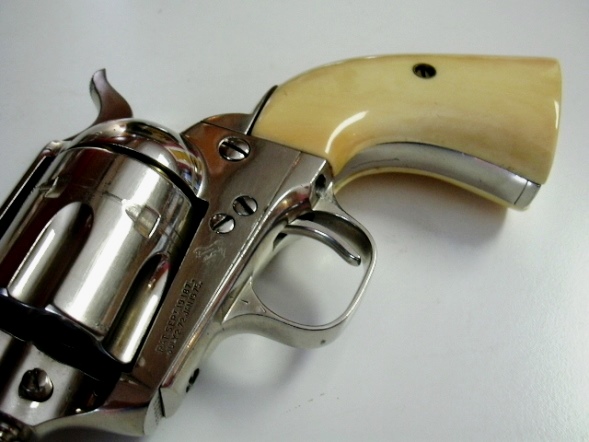
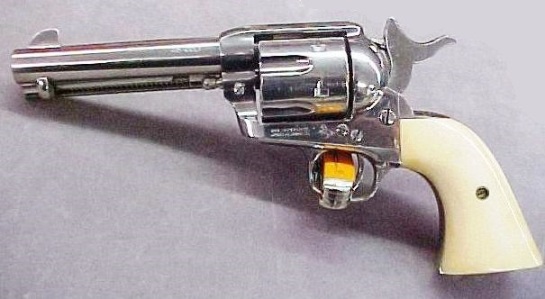
Collector Snapshot
- Finish
- Nickel
- Barrel Length
- 4.75 inches
- Caliber
- .45
- Grips
- Elephant ivory
First-Generation Colt SAA Context
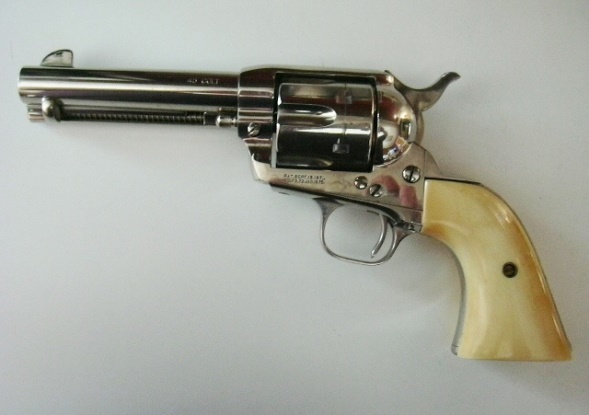
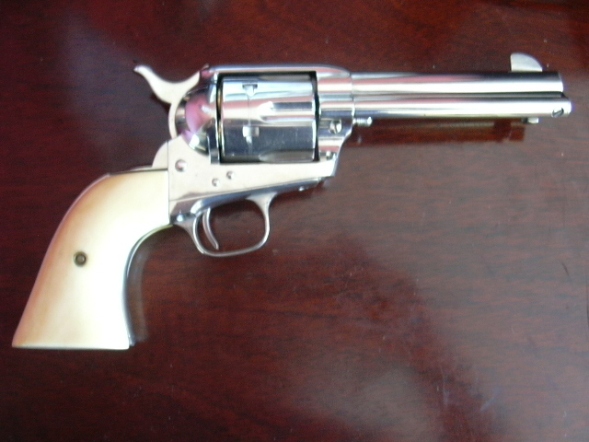
The Peacemaker pictured here is a “First Generation” Colt Single Action Army chambered in .45 caliber. In collector terms, first-generation Single Action Armys are those produced from 1873 until wartime production halted in 1941, with the main pre-war serial-number sequence ending at 357859 and without the later “SA” letter suffixes.
All-original, good-condition first-generation Colt SAAs are among the most valued examples for collectors. That is exactly why originality, finish, and documentation matter so much when evaluating one of these revolvers.
Production Years and Transition Years
The Colt Single Action Army was adopted during the metallic-cartridge revolver era and entered production in 1873. Collectors usually divide the model into three broad production generations: first generation pre-war guns, second generation post-war revival guns, and third generation/current-production guns. The featured revolver is a first-generation example that shipped in 1931, late enough to be a smokeless-powder-era Colt but early enough to belong to the pre-war production story.
The first generation ran from 1873 until Colt halted SAA production during World War II, with 357859 commonly cited as the final pre-war serial number. A few “pre-war/post-war” Single Action Armys were later assembled from leftover parts, usually in the high 356000 and 357000 serial ranges, which makes those guns a true collector transition area rather than a simple year chart.
| Period | What changed | Collector meaning |
|---|---|---|
| 1873 introduction | Colt introduced the Single Action Army as a .45-caliber service revolver with a 7½-inch barrel and U.S. military markings on contract examples. | Earliest U.S.-inspected cavalry revolvers, especially with documented inspector marks, are among the most studied SAA collectibles. |
| 1874-1879 civilian expansion | Nickel finish appeared early; 5½-inch “Artillery” and 4¾-inch “Civilian” barrel lengths entered the market; .44-40 Frontier Six Shooter models appeared in 1878. | Shorter barrels, nickel, ivory or pearl stocks, and .44-40 markings create major collector subcategories. |
| 1882-1900 mechanical and finish-era changes | Hard-rubber/gutta-percha stocks replaced early walnut on many guns, the base-pin retaining system changed, and Colt later warranted SAAs for smokeless powder around serial 192000. | Black-powder-frame versus later smokeless-era features are important transition-year details. |
| 1920s-1941 late first generation | Sights became more visible in the 1920s, and production slowed before wartime priorities ended regular pre-war production. | Late first-generation guns like this 1931 shipment can be attractive when original, but refinishing sharply changes the collector equation. |
| 1955/1956-1975 second generation | Colt revived the Model P after the Western television boom, using “SA” suffix serial numbers and much of the older production character. | Second generation examples have become collectible in their own right, especially early guns, scarce chamberings, boxed guns, and documented special-order examples. |
| 1976 onward third generation | Production resumed after retooling with 800000SA and then later SA-prefix and S-prefix/A-suffix serial formats, along with Custom Shop, commemorative, Sheriff’s, Storekeeper’s, and Buntline variations. | Third generation guns are modern Colts, not first-generation antiques; they must be priced and authenticated within their own generation. |
Variants, Barrel Lengths, Finishes, Grips and Special Configurations
The Single Action Army is simple in outline but complicated in collector detail. Barrel length, finish, grip material, caliber, military markings, engraving, special sights, and factory documentation can move two similar-looking Peacemakers into completely different value categories.
Serial Number Ranges and Collector-Observed Anchors
Serial numbers are the starting point for any Colt SAA evaluation, but they are not the finish line. Colt’s own public lookup describes its data as approximate and not comprehensive, and vintage Single Action Army records can require a paid archive letter for definitive shipment and configuration details.
| Generation / period | Approximate serial-number pattern | Collector note |
|---|---|---|
| First Generation, 1873-1941 | Plain numeric serials from the beginning of production through 357859 | No “SA” suffix. This is the main antique/pre-war collector group and the generation of the featured revolver. |
| Pre-war/post-war leftover assemblies | Mostly high 356000 and 357000 serial ranges | Scarce transition examples assembled from leftover parts; authentication is especially important. |
| Second Generation, 1955/1956-1975 | SA-suffix format, commonly beginning around 1001SA and ending at 73319SA | Revival-era Peacemakers with their own collector following; cylinder and serial placement details differ from first-generation guns. |
| Third Generation, 1976-1978 transition | 800000SA and related early third-generation numbering | Early third-generation guns can be confused with second-generation examples if judged only by an “SA” suffix. |
| Later Third Generation / current pattern | SA-prefix after SA99999, then later S-prefix/A-suffix numbers | Modern-production and Custom Shop guns should be valued as modern Colts unless unusual factory documentation says otherwise. |
Collector Notes: What to Look For
The Colt Peacemaker rewards patient inspection. The most valuable examples are not merely old; they are original, correctly configured, documented, and honestly represented. This page’s featured revolver is attractive, but the refinish disclosure is the heart of the lesson.
- Fit and finish quality: look for sharp barrel lettering, crisp patent dates, clean screw slots, correct case colors, honest blue or nickel wear, and edges that have not been rounded by buffing.
- Desirable years: early U.S.-inspected cavalry guns, black-powder-frame examples, early civilian configurations, and documented late first-generation guns can all attract interest for different reasons.
- Desirable barrel lengths: 7½-inch cavalry, 5½-inch artillery, and 4¾-inch civilian barrels are the classic groups; documented special-order short or long barrels can bring premiums.
- Rare markings: U.S. property marks, inspector initials, London proofs, acid-etched “Frontier Six Shooter” markings, factory engraving, agency markings, or special sights should be photographed and researched.
- Packaging and paperwork: original boxes, end labels, factory letters, old receipts, provenance, and period holsters can dramatically improve buyer confidence.
- What collectors avoid: unmentioned refinishes, buffed markings, cut barrels, mismatched grip frames, replacement cylinders, modern engraving passed as factory work, and undocumented celebrity stories.
Known Issues and Inspection Notes
Most Peacemaker issues are collector and condition issues rather than modern “recall” issues. These revolvers can be more than a century old, and small changes can have large value consequences.
Value Trends
Colt SAA values remain strongly condition-sensitive. Ordinary modern or third-generation examples occupy a different market than first-generation antiques, U.S. military-marked guns, factory-engraved guns, celebrity-provenance revolvers, or documented rare configurations. Broad online value trackers show ordinary Single Action Army averages in the low-thousands in 2026, but the spread is enormous once generation, originality, caliber, barrel length, finish, documentation, and provenance are considered.
Values have generally favored original, documented Colts over refinished or altered examples. Early military guns, rare inspector marks, factory engraving, original nickel, special-order barrels, desirable calibers, and complete paperwork can multiply value. By contrast, a visually impressive refinish may sell for far less than a plainer gun with honest original finish.
- Early models command a premium: first-generation guns lead the collector conversation, especially when original and documented.
- Nickel can bring more: original nickel is desirable; refinished nickel is a different value category.
- Box and papers matter: archive letters, correct boxes, and original paperwork can greatly improve marketability.
- Documentation beats stories: shipment destination, special-order features, engraving, and historic ownership should be supported by a factory letter or credible provenance.
The Colt Archive Call
This gun shipped to St. Joseph, Missouri, on January 2, 1931. After it arrived, I checked the serial numbers and called the Office of the Historian, Colt Archive Properties, LLC in Hartford, Connecticut, to order a letter of authentication.
I expected a long wait because the authentication letter I had ordered for my Colt Python had taken 125 days to arrive. Instead, after taking my credit card information, the lady on the phone asked whether I would like to hold for a moment while she checked the serial number.
Less than a minute later, she came back with the same kind of information normally contained in the letter of authentication. When I asked how that was possible, she explained that Colt’s Single Action Army records were more readily accessible than the records for the Python.
Collector Insight
The Value Lesson Was Expensive
I paid $3,600 for this Colt and sold it for $2,000 in 2006 with full refinish disclosure. The loss was the lesson: condition and originality can matter more than configuration, story, or appearance.
Peacemaker Photo Gallery
The photos below preserve the original page’s visual record of this Colt Single Action Army, including the nickel finish, ivory grips, and period character that made the gun attractive despite the refinish issue.
The Bat Masterson Comparison
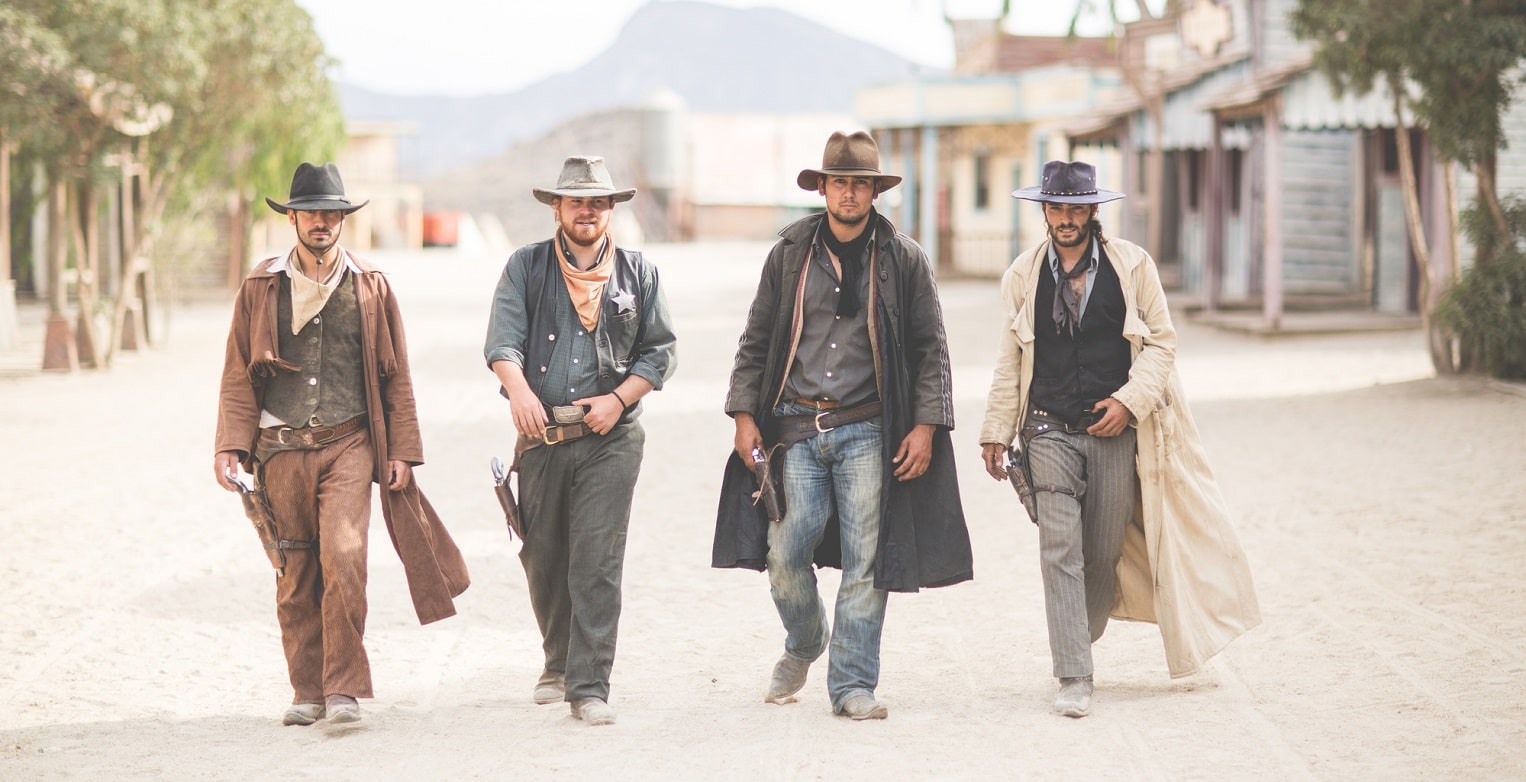
Bat Masterson is strongly associated with nickel-plated Colt Single Action Army revolvers, and documented Masterson orders included .45-caliber nickel Colts with special sights and, in some records, ivory-stocked configurations. This is not a Bat Masterson gun, but the nickel, short-barrel, ivory-grip appearance echoes the kind of frontier-era special-order style collectors recognize.
Collector Takeaway
For collectible Colts, start with the serial number, document the factory information, compare the configuration to known production ranges, and study the finish before falling in love with the photographs. A refinish may still leave you with a beautiful revolver, but it changes the collector equation dramatically.
From My Bench
For holsters, leather, storage, and related accessories, verify the exact model and barrel length before ordering. Collector firearms deserve careful handling, safe storage, and gear that fits correctly.
Browse Colt HolstersAs an Amazon Associate I earn from qualifying purchases. The firearms on these pages are not for sale.

About Greg Cook
Greg Cook writes about firearms collecting, personal history, and the stories behind interesting guns. His Army MOS was 76Y, Unit Armorer, and he brings that practical background to his collector articles.
Research Sources Consulted
This article updated and cross-checked against current and historical Colt Single Action Army references.
- American Rifleman / NRA: “150 Years Of The Colt Single Action Army” — production generations, first-generation totals, barrel lengths, finishes, transition years, and special-order context.
- American Rifleman / NRA: “Collecting Second Generation Colt Single Action Army Revolvers” — second-generation serial and variant details.
- Colt Serial Number Lookup — public lookup caveats and approximate date guidance.
- Colt Archive Services — factory-letter authentication and shipment-detail documentation.
- TrueGunValue: Colt Single Action Army current price and value trends — 2026 online market context for ordinary new and used examples.