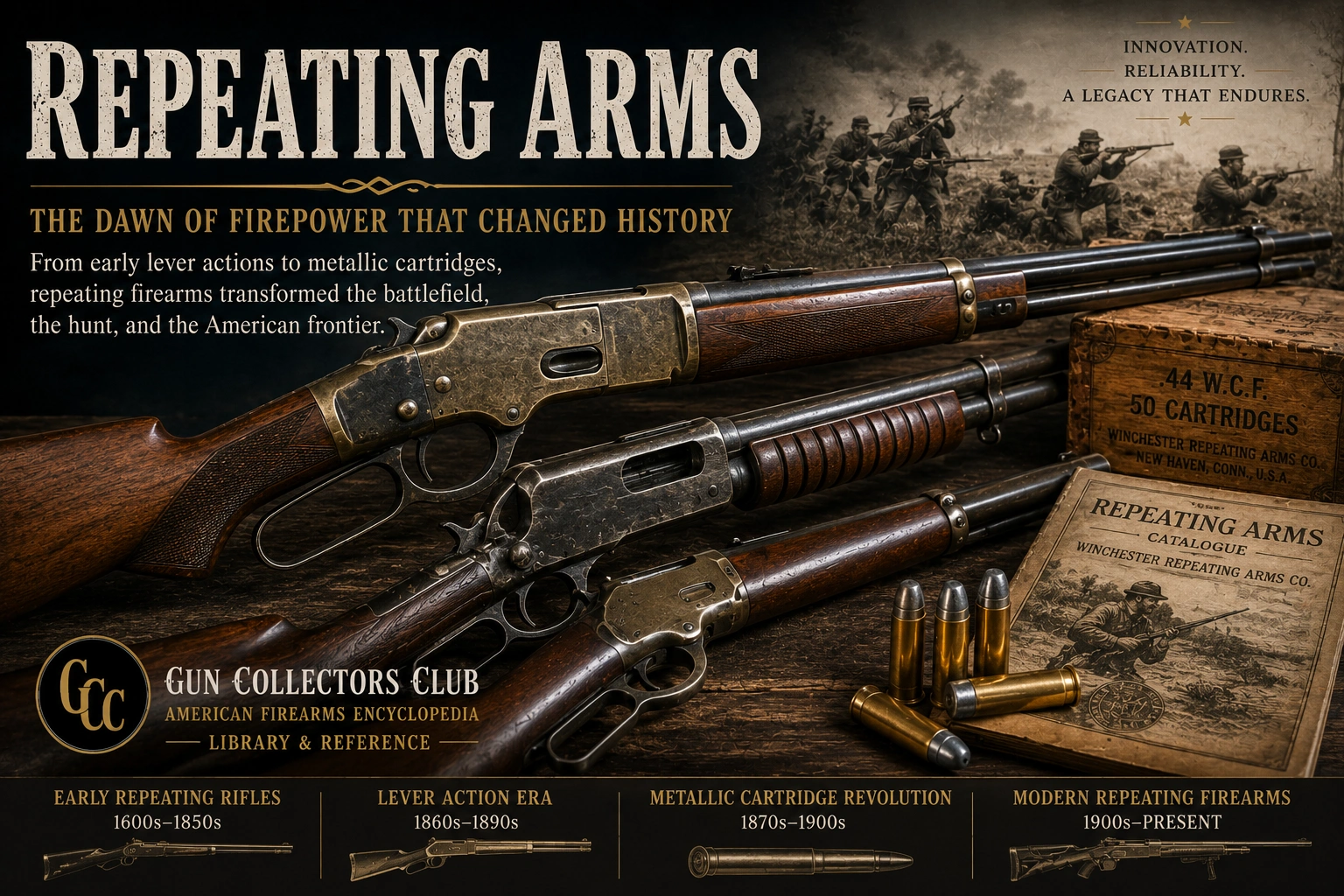
Repeating Arms is part of the Gun Collectors Club American Firearms Encyclopedia. These encyclopedia entries connect firearm design, manufacturing history, military use, sporting culture, and collector evaluation into one reference system.
The goal is not merely to define a firearm term. The goal is to explain why the subject mattered, how it connects to other American firearms, and what collectors should study before drawing conclusions about age, value, originality, and historical importance.
In the American Firearms Encyclopedia, every entry should lead the reader deeper into the collection — from design idea, to production era, to collector meaning.
What Repeating Arms Changed
Repeating arms are firearms capable of firing multiple shots before being reloaded. That sounds simple today, but it represented a major break from the single-shot mindset that dominated earlier military and sporting arms.
For collectors, repeating arms are a bridge between early percussion technology, metallic cartridges, lever actions, pump actions, bolt actions, and magazine-fed modern firearms.
Civil War Repeaters and the Spencer Legacy
The Civil War revealed the practical advantage of repeat-fire arms. The Spencer repeating rifle and carbine, along with the Henry rifle, showed that a soldier or cavalryman with multiple shots available had a very different battlefield capability than one carrying a muzzleloader.
Adoption was not instant or universal. Ammunition supply, cost, training, and conservative military thinking all slowed the transition.
Winchester, Henry, and Lever-Action Development
The repeating-arms story naturally leads to Winchester and Henry. Lever-action rifles became one of the most recognizable American repeating systems, shaping frontier imagery, hunting culture, and sporting rifle collecting.
The Winchester 1873 and 1894 are not isolated models; they are part of the repeating-arms revolution.
Collector Perspective
Collectors evaluate repeating arms by action type, cartridge, production era, originality, mechanical condition, and historical association. A repeating arm with period-correct features, honest finish, and clear provenance can tell a far richer story than a heavily altered example.
The Evolution of Repeating Firearms
The repeating firearm did not arrive all at once. It evolved through decades of experimentation involving tubular magazines, metallic cartridges, stronger steel, improved machining, and the growing realization that soldiers and civilians both valued rapid follow-up shots. Collectors often focus on the famous names — Henry, Winchester, Spencer, Marlin, Colt — but the larger story is really about industrial confidence. Once manufacturers could reliably produce interchangeable parts and metallic cartridge systems, the age of practical repeating arms accelerated quickly.
For modern collectors, repeating firearms represent one of the most important turning points in American arms history. Earlier muzzleloading systems required a completely different mindset. A repeating rifle changed not only reload speed, but confidence, tactics, hunting methods, and even western folklore. The rise of the lever-action rifle became tied directly to frontier mythology, railroad expansion, ranch culture, and sporting use throughout the late nineteenth century.
Collectors also study repeating arms because these firearms show manufacturing evolution in visible ways. Early examples often display hand-fitting, machining marks, evolving loading systems, changing sights, and transitional features that disappeared only a few years later. Small production changes can significantly affect rarity and value today. A seemingly minor alteration in barrel address, loading gate shape, stock profile, or cartridge designation may separate a common rifle from a highly desirable collector variation.
The transition from lever-action repeaters to pump actions, bolt actions, and eventually semi-automatic rifles also helps collectors understand how firearms technology matured over time. Many collectors begin with a single Winchester or Marlin, then gradually realize those rifles connect directly to military repeaters, sporting rifles, and even modern magazine-fed systems. That historical continuity is part of what makes repeating arms such an enduring category within American firearms collecting.
Collector Considerations
Original finish remains critically important with repeating firearms. Many lever-action rifles spent decades in barns, saddle scabbards, hunting camps, and truck racks. Honest wear is expected, but aggressive polishing, refinishing, cut barrels, replacement wood, and drilled receiver modifications can substantially reduce collector value. Factory letters, provenance, period accessories, and documented family ownership can all add historical depth to a repeating firearm.
Collectors should also pay close attention to caliber markings and production eras. Certain chamberings were produced only briefly, while others were heavily used and survive in large numbers today. Early smokeless-era transition rifles are especially interesting because they often reflect the overlap between black-powder engineering and modern cartridge pressures. Those transition periods frequently create some of the most collectible variations in the entire repeating-arms category.
| Collector Question | Why It Matters |
|---|---|
| What repeat system is used? | Lever, pump, bolt, tube magazine, box magazine, and other systems define collector category. |
| What cartridge does it use? | Cartridge technology often explains why the design succeeded or failed. |
| Is the firearm mechanically original? | Altered magazines, changed barrels, and refinished parts affect value. |
| Does it connect to a major era? | Civil War, frontier, sporting, and military periods shape collector demand. |
Encyclopedia Insight
The repeating arm changed the rhythm of firearms history.
Once a shooter could fire multiple shots without pausing to reload, everything changed: battlefield tactics, hunting expectations, firearm design, ammunition supply, and eventually the entire collector map.
Related Encyclopedia Entries
Build Your Reference Shelf
Encyclopedia-style collecting works best with good books, careful photography, magnification, and a slow research process. I keep a curated list of reference books and collector tools for this kind of work.
Shop My LibraryAs an Amazon Associate I earn from qualifying purchases.

About Greg Cook
Greg Cook writes about firearms collecting, personal history, and the stories behind interesting guns. His Army MOS was 76Y, Unit Armorer, and he brings that practical background to his collector articles.