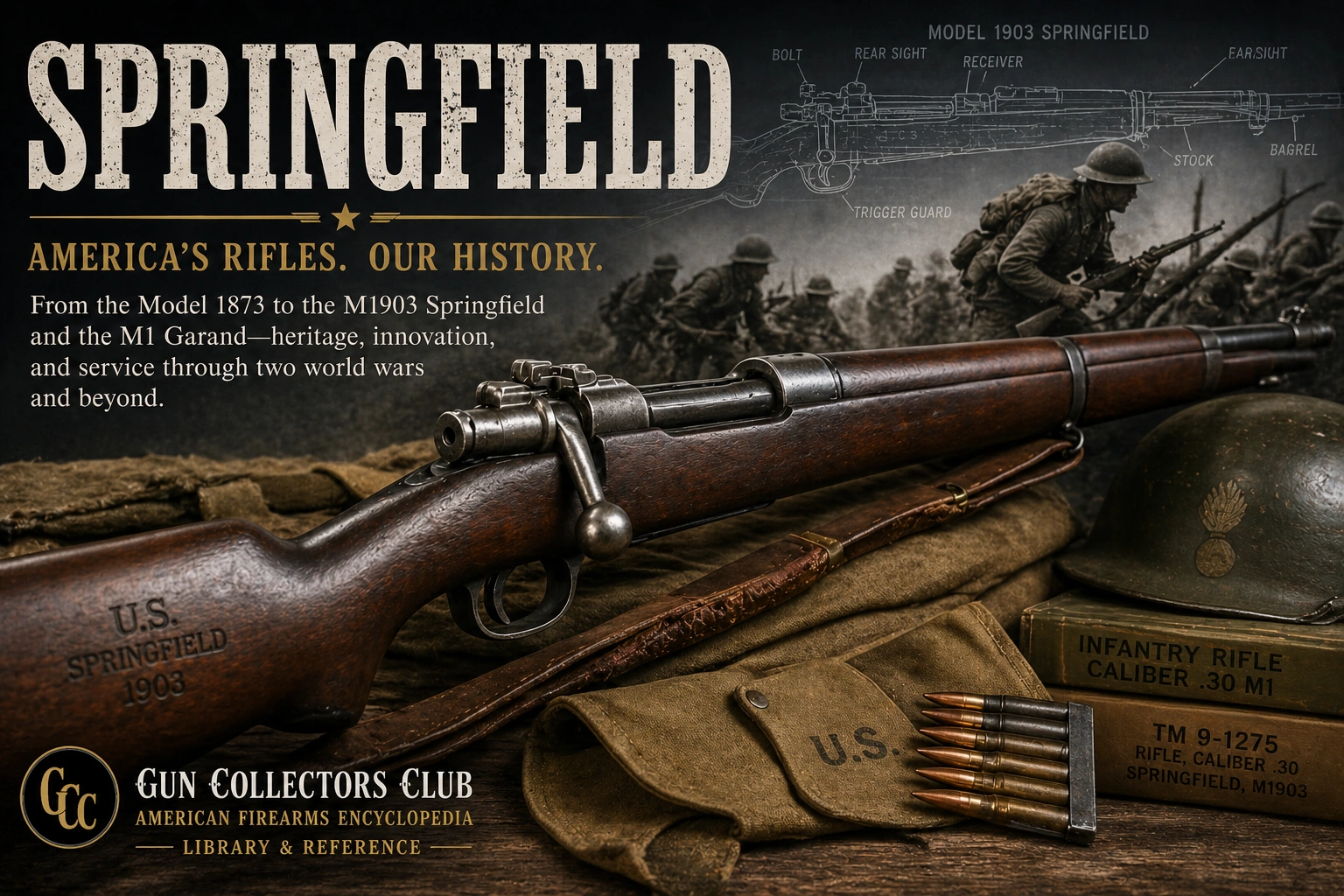
The Springfield rifle – incredible legacy left by the Springfield Armory!

A 1962 Colt Python, 1992 Colt Mustang and a 1968 Baby Browning.

Pictured: Remington Model 90-T Trap Gun


Springfield Armory had meant for the American firearm history more than any other company, being a place where innovation and new technologies were always welcomed. From 1794 and till 1968, the Armory had provided weapons for the American Civil War and other major events. The site where Springfield Armory was located had been chosen by President George Washington himself, being more opportune for business. It offered access to major highways and also to the Connecticut River, being at a safe distance from opposing military forces. The President was confident that Springfield Armory had everything needed to produce both firearms and ammunition, and yet it wasn’t until 1794 that weapons started to be produced.
 

Until 1794, Springfield Armory was one of the major American depots for ammunition and firearms. It supplied the American Revolution with muskets, cannons and other similar weapons, including ammo. When the Federal Government decided that it was high time for American forces to start relying on their own arms, Springfield Armory was selected as one of the first places to begin the production of flintlock muskets. From that time and for many years to come, Springfield represented a place where clever men presented their skills and abilities, always inventing forward-looking systems and weapons of the latest generation. Thomas Blanchard was one the men that contributed to the fame of Springfield Armory, designing in 1819 a special system that allowed for the first rifle mass-production. Soon, more innovations were to come for the Springfield Armory and in 1840s the flintlock musket was replaced with a new generation of firearms, using a percussion ignition system. The revolutionary firearms had the advantage of being highly effective and at the same time easy to use.


The name of Springfield Armory is strongly linked to the development of the Industrial Revolution, the armory being a place where all modern discoveries were being implemented. Military officials were deeply interested in the possibility of replacing broken firearm parts, rather than trying to repair them on the front. The mass production of rifles and interchangeable parts led to an even greater demand for technology, increasing at the same time the need for labor. Springfield Armory contributed to the history of American firearms, being the only place where small arms were manufactured until the start of the 20th century. In 1865, a brilliant man in the person of Erskine Allin introduced a new breech-loading mechanism, which was incredibly well received.
 

The year of 1891 brought a fresh change for Springfield, the Armory being chosen by the army as a testing ground for small arms. At that time, the United States military forces used Krag rifles and army officials were interested in having better weapons. They used Springfield Armory to test an experimental magazine rifle, one that surpassed the Krag rifle in many ways. The magazine used a clip-loading system, having the cartridges contained within the stock and offering better protection. This was one of the first innovations produced at Springfield and it was named Springfield ’03. The 1903 model was one of the most popular guns manufactured during the First World War, an incredible number of 800.000 rifles being produced. In 1919, John Garand came to work for Springfield and developed for the Springfield Armory one of the first semi-automatic rifles. It took another five years for the famous Garand Rifle to enter production and another twelve years for the US Army to adopt it. Still, when military forces realized the incredible potential the M1 had, they ordered an even higher number of weapons. Today, history records of an unbelievable number of 4 million Garand Rifles produced by the Springfield Armory. The gun earned quickly the appreciation of US military forces, including famous personalities such as General Douglas Mcarthur and General George S. Patton. They both considered the Garand Rifle to be extremely accurate and highly effective, delivering superior firepower. Another famous small arm developed by Springfield armory was the 14 model, constantly developed over the years, until the modern 21 model, the standard sniper rifle used by the US military. As far as the Vietnamese war is concerned, Springfield Armory produced not only its famous rifles, but also a wide variety of machine guns suitable both for ground and air battles, not to mention grenade launchers and other additional equipment.

The site of Springfield Armory is today a national historic site, an incredible museum and it also hosts the Springfield Technical Community College. In 1974, the Springfield Armory was taken over by Robert Reese, starting the production of semi-automatic versions of the already famous M14 rifle. The business was continued by Reese’s sons and they now produce a wide variety of firearms under the Springfield name, however at another location site.

The 1840 Springfield rifle was one of the most innovational flintlock muskets for its times, having a 42’’ barrel and firing a 69 caliber cartridge. It was produced in over 30.000 units and not before long a large percent of them were converted to percussion cap muskets. These muskets represented the 1842 Springfield percussion musket and they had a rather interesting story to tell. While they were the last muskets to ever use a smoothbore mechanism, at the same time they were the first muskets that had completely interchangeable parts and an innovative percussion lock. They fire the same 69 caliber and weighed 10 pounds. The 1855 model was forward-looking, having a uniquely shaped hammer and the magazine outside the stock. Invented by Doctor Edward Maynard, it used the same percussion mechanism and was first tested somewhere in the Pacific, during the Battle of Four Lakes. The American forces quickly dispersed the enemy forces and the gun gained even more popularity. However, its design was changed and improved for the American Civil War.

The 1861 Springfield rifle musket was probably one of the most renowned firearms ever manufactured by Springfield Armory. It was extensively used by the American army during the Civil War and especially prized for its accuracy and dependability. It had a long barrel of 40 inches, fired a 58 caliber and weighed almost 9 pounds. The effective range was incredible, being of almost 600 paces and soon the Armory was overpowered with the increased demand. It soon entered in partnership with other private producers, including the famous Samuel Colt who improved the barrel, adding a new hammer and an innovative bolster to the 1861 model. The new model had a bayonet attached and it represented a fresh change for US small arms manufacturing industry, being produced on a larger scale than any other shoulder rifle.

In 1863, the 1861 model suffered minor modifications, including a new barrel, ramrod and hammer. Over 50000 models were produced and today this firearm is recognized to have been extensively used in the Civil War. As for the next models, the 1865 Springfield rifle was the first of the many breech-loading rifles that were about to come. The cartridge was loaded at the breech and it allowed for further improvements of the original prototype designed. The next models served as a foundation for the more than famous 1873 model rifle, being the single most used breech-loading rifle by the American Army in the Black Hills War and also in another fights against Native Americans. Some of the previous models were manufactured by Remington Arms and they had an innovative trapdoor breech-block system.

Springfield Armory did not stop and came out with the first officer’s rifle in 1875. Soon after, they started to produce carbines, short rifles and bayonet rifles. They were constantly looking to produce firearms that were precise, reliable and effective. The Springfield rifle is an important addition to the American firearms history, serving in various wars and significant battles. It stands as a solemn statement of quality and superior service, just like many other firearms produced in the land of all possibilities.


Semi-Autos:  
1908 Colts: 24kt gold plated, fully engraved with mother of pearl. Colt Mustang: .380 caliber, baby 1911 - DOM 1992, real mop.
1908 Colts: 24kt gold plated, fully engraved with mother of pearl. 1908 Colts: 24kt gold plated, fully engraved with mother of pearl.
1911 Colt: For nine decades the Colt Government Model 1911 has been without challenge the most ... 1911 Colt: For nine decades the Colt Government Model 1911 has been without challenge the most ...
Colt Officer's Model: Slightly smaller than a Government Model, with the barrel length reduced from 5" to 3.5".
Browning .25 Caliber Automatic Pistol: The 1968 Gun Control Act stopped the importation of these guns.
Colt 1903 Pocket Hammerless .32: Produced from 1903 to 1945.
Colt 1908 Hammerless .25 (Vest Pocket) Model N was made in 1916.
Revolvers:  
Colt .32 Detective Special: Made in 1950, this gun is chambered in the .32 New Police cartridge (.32 S&W Long).
If you're interested in collecting Colt Single Action Army guns, click here for information that could make or save hundreds or thousands of dollars. Peacemaker: The Colt Single Action Army - this is a first generation gun.
Colt Python: Pythons produced from 1955 to 1969 have no letter in the serial number and are the most desirable to collectors.
Detective Special: One of the most well known and most copied guns in the world.
Colt Cobra: It was an earlier version of this gun Jack Ruby used to kill Lee Harvey Oswald.
Ruger .22 Single Six: Commonly referred to as a "Flat Gate".
Holsters:  
Gun Holsters and Various Methods of Carry: The holster is a very important part of "concealed carry".
Holster Gallery: Pictures of holsters that I have found to be of good quality as well as design, functional, easy to use and a good value.
Rifles:  
Colt Sauer Rifle: Bolt Action, 30.06 caliber, 24" bbl., magazine capacity 3 or 4 rounds.
Winchester .30-30: Lever Action, 30.30 caliber, saddle gun.
Shotguns:  
1908 Colts: 24kt gold plated, fully engraved with mother of pearl. Browning A-5: Auto 16 gauge short bbl, stamped U.S. Property.
Remington 90-T Trap Gun Remington Model 90-T: A Single-Shot 12 Gauge Trap gun with a 34" bbl, Full Fixed Choke, low vent rib and adjustable comb stock.
1908 Colts: 24kt gold plated, fully engraved with mother of pearl. Remington Pump: Pump action 12 gauge with stamped patent dates...
Abercrombie & Fitch: 12 Gauge, Single Shot, 32" bbl., full fixed choke, made by Renato Gamba for Abercrombie & Fitch about 1978.
Ads: