|
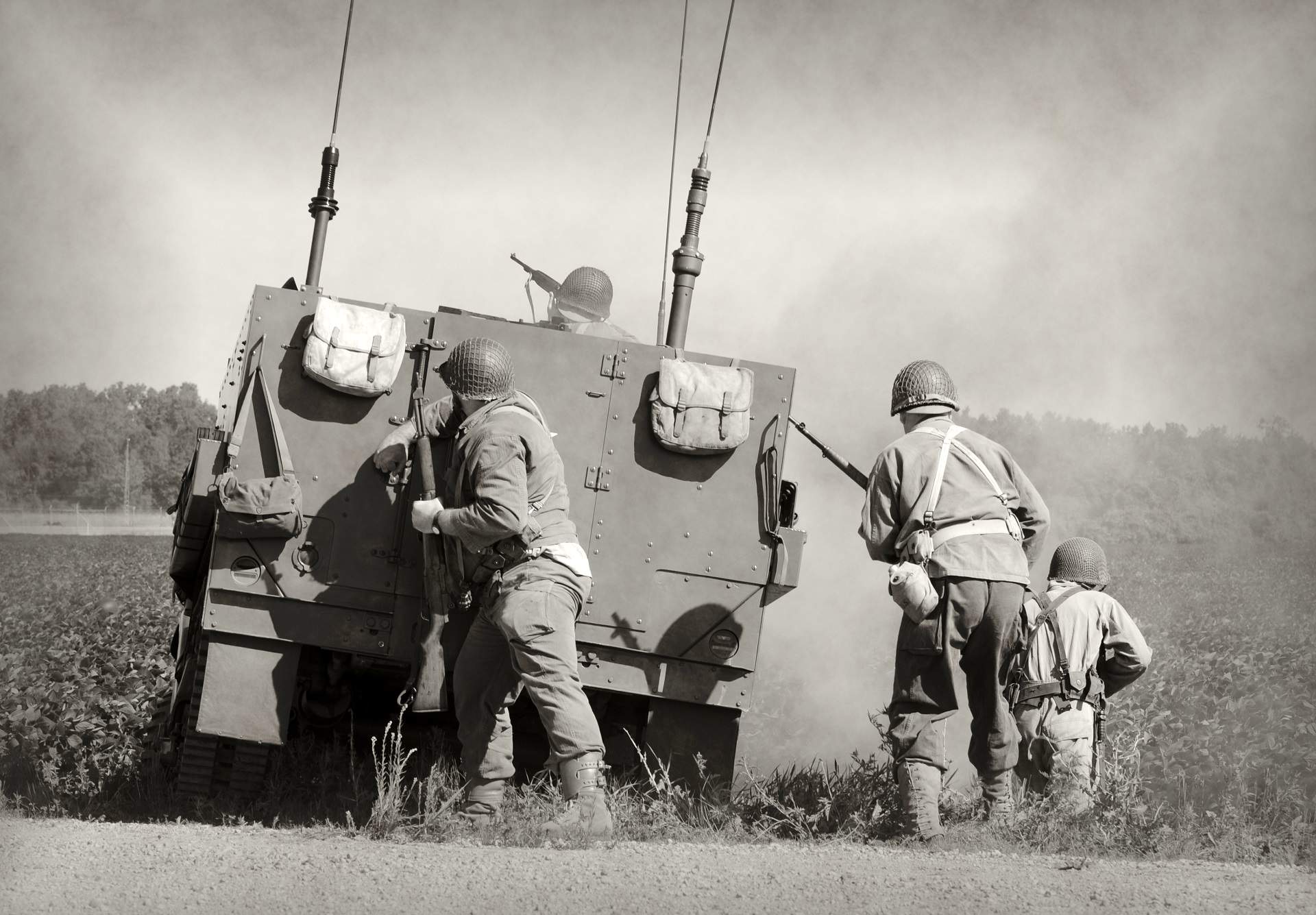
World War II and the
Supremacy of American Firearms
|

Pictured: 1969 Winchester Lever Action Rifle
.30-30
|
The Second World War had meant a lot for everyone.
Countries fought for diverse reasons and they all tried to prove
their supremacy when it came to the firearms they used. The United
States had an entire arsenal of firearms, designed and manufactured
by ingenious men and managed to overpower other countries. Important
personalities like John Browning, General Thompson or Oliver
Winchester have brought their own personal contribution to the war,
designing handguns, submachine guns or rifles.
|
John Browning was mainly responsible for supplying the United States
with some of the best handguns that were ever made. The Browning
Hi-Power was an innovative semi-automatic pistol, based on the
single-action mechanism and was chambered for a 9 mm caliber. It was
first patented in 1922 by Browning himself and then carried own for
production in Belgium. After four years, sadly, John Browning died and
the production of the Browning Hi-Power was taken over by another
firearms designer, this time a Belgian. There were certain
characteristics that impressed about the Browning Hi-Power, including
the 13 round magazine capacity, the double-column magazine and the
incredible firepower it offered. The two original models were constantly
redefined and improved, even though they kept on operating the
short-recoil system. As for the use during the war, the firearm was used
the United States, Canada and other allied forces. They all appreciated
the locked-breech, semi-automatic, single-action pistol.
 |
Another handgun that was extensively used during the World War
II was the 1911 model from Colt. It was a single-action,
semi-automatic handgun designed by the same John Browning and
quickly became a standard for the American armed forces. Using the
same short-recoil system, the firearm became one of the most popular
designs bearing the name of John Browning and had undergone major
changes throughout time. After replacing the revolvers that were
back then in use, the M1911 started to be widely adopted by the
Armed Forces, entering many battlefields and leading the way for
international manufacturing. During the WWII, the firearm was used
by German forces as well, who captured them from American soldiers.
After the war, the M1911 maintained its popularity but it was soon
replaced with new and improved models. It remains in use up to this
day, especially by those who enjoy taking part in sporting shooting
competitions. |
The Second World War meant a serious
increase when it came to the number and power of firearms used. The 1917
Revolver was introduced to supplement the activity of the already famous
M1911, two manufactures being personally asked to enter production: Colt
and Smith & Wesson. The Army adopted it and the revolver was extensively
used during the war, being chambered for the powerful 45 ACP cartridge.
The model manufactured by Colt resembled in many ways a previous
revolver, the M1909 having only slight modifications. First used in the
WWI, the firearms continued to stay in use during the WWII and also in
the Vietnamese war.
In 1942, the United States came out on the market with a new pistol
called the FP-45 Liberator. It was a single-shot pistol and started to
be mass-produced as quickly as possible. The most interesting part was
the unrifled barrel and the firearm was particularly adapted for the 45
caliber. The unrifled barrel allowed only for a short efficient range,
of maximum 8 meters. The firearm was especially prized for the
psychological effect it had but also for the incredible performance. It
was used by resistance forces, including the Chinese but never got to be
released for American troops. The Liberator was replaced in 1964 and
started to be offered for use in the Vietnamese War.
The Second World War saw the extensive use of not only handguns but also
of submachine guns. The Tommy gun (designed by General Thompson himself)
is perhaps one of the most popular and representative examples, being
increasingly used with the incredible automatic fire and powerful 45 ACP
cartridge. Another submachine gun that used the same cartridge and was
widely used during the WWII was the M3 submachine gun. It replaced the
Tommy gun, being one of the best automatic blowback operated firearms.
The gun had a removable magazine and also a detachable rifled barrel.
There were many variants of the M3, including the modern M3A1 with new
and innovative features.
Rifles were standard firearms during the WWII and the M1 Carbine (30
caliber) was by far one of the most popular. The semi-automatic rifle
was easy to carry and had a great deal of interesting features. It was
not only used during the Second World War but also in the Vietnam War.
Certain versions had the capacity of fully-automatic fire and the latest
models are equipped with infrared scope systems. The 1903 model from
Springfield was another rifle used in the war. It was chambered for a 30
caliber and it operated on a bolt-action mechanism. It didn’t take too
long for it to be replaced by the modern semi-automatic M1 from Garand.
However that may be the case, the Springfield ’03 was greatly used
during both World Wars and also in the Korean War. As for the M1 Garand,
it was chambered to use the same 30 caliber but it had a faster firing
capacity.
Winchester remained as a famous name associated with the history of
American firearms during warfare periods. The 1897 Winchester model was
a pump-action shotgun that had an external hammer and also a tubular
magazine. The gun had various advantages and was used in both World
Wars. As for the 1912 Winchester, it was also a pump-action shotgun but
it had certain improvements versus the previous model mentioned. It was
chambered for various gauges, including the 20, 12 and 16. The firearm
was used by the military forces during WW I and II, Vietnamese and
Korean War. During the Second World War, the M1912 was purchased in
large quantities (up to 80.000 numbers) and were widely employed by the
Marines, Aircraft Forces and also by the Navy.
The contribution of John Browning was also highlighted by the extensive
use of his machine guns during the war. The Browning automatic rifle
included more automatic rifles that were extensively utilized during the
Second World War, chambered for the 30-06 Springfield cartridge. From
all the firearms designed by John Browning, the M1919 was widely used,
during the World War II and also in the Korean War. The M2 machine gun
was also preferred during the war, due to its being heavy and especially
preferred by the infantry. As for the Browning 50 machine gun, it was
one of the most utilized heavy machine guns during the World Wars, the
Vietnam War and the Korean War. It is still being used by diverse NATO
countries and resembled very much the M1919 model from John Browning.
The Second World War was considered to be one of the most lethal human
conflicts. The extensive use of firearms increased the number of deaths
but as the same time helped to the saving of many other lives. During
the war, the firearm production increased to unexpected levels and many
discoveries were made. The United States not only got out of the war
being regarded as a superpower but they also demonstrated their
supremacy when it came to the production and design of revolutionary
firearms.
|
 
NEW!
"Gun News" section of guncollectorsclub.com, where you can read about and comment on Gun
News
|
Semi-Autos: |
|
 |
Colt Mustang:
.380 caliber, baby 1911 - DOM 1992, real mop. |
 |
1908 Colts: 24kt
gold plated, fully engraved with mother of pearl. |
 |
1911 Colt:
For nine
decades the Colt Government Model 1911 has been without challenge
the most ... |
 |
Colt Officer's Model:
Slightly smaller than a Government Model, with the barrel length
reduced from 5" to 3.5". |
 |
Browning .25 Caliber
Automatic Pistol: The 1968 Gun Control Act stopped the
importation of these guns. |
 |
Colt 1903 Pocket
Hammerless .32: Produced from 1903 to 1945. |
 |
Colt 1908
Hammerless .25 (Vest Pocket) Model N was made in 1916. |
|
Revolvers: |
|
 |
Colt .32 Detective Special:
Made in 1950, this gun is chambered in the .32 New Police cartridge
(.32 S&W Long). |
 |
Peacemaker:
The Colt
Single Action Army - this is a first generation gun. |
 |
Colt Python:
Pythons produced from 1955 to 1969 have no letter in
the serial number and are the most desirable to collectors. |
 |
Detective Special: One of the most well known and most
copied guns in the world. |
 |
Colt Cobra: It was an
earlier version of this gun Jack Ruby used to kill Lee Harvey
Oswald. |
 |
Ruger .22 Single Six: Commonly referred to as a "Flat
Gate". |
| Holsters: |
|
 |
Gun Holsters and
Various Methods of Carry: The holster is a very important
part of "concealed carry". |
 |
Holster Gallery:
Pictures of holsters that I have found to be of good quality as well
as design, functional, easy to use and a good value. |
| Rifles: |
|
 |
Colt Sauer Rifle:
Bolt Action, 30.06 caliber, 24" bbl., magazine capacity 3 or 4 rounds. |
 |
Winchester .30-30:
Lever Action, 30.30 caliber, saddle gun. |
|
Shotguns: |
|
 |
Browning A-5:
Auto 16
gauge short bbl, stamped U.S. Property. |
 |
Remington Model 90-T:
A Single-Shot 12 Gauge Trap gun with a 34" bbl, Full Fixed Choke,
low vent rib and adjustable comb stock. |
 |
Remington Pump: Pump action 12
gauge with stamped patent dates... |
 |
Abercrombie & Fitch: 12 Gauge, Single Shot, 32" bbl.,
full fixed choke, made by Renato Gamba for Abercrombie & Fitch about
1978. |
|
Ads: |
|
|