
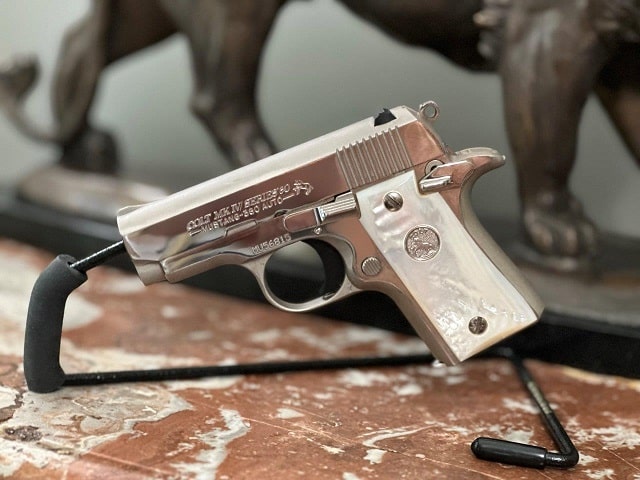
Ideal for concealment, the Colt Mustang is an all-time favorite. The original owner described this as a 1992 gun, but when my Colt Archive letter arrived, I learned it shipped on December 10, 1991. Either way, this Mustang ranks very high on my list of collectibles.
For a broader factory-date check, consult the Colt Mustang production research in the Colt serial-number lookup tool.
I have always been partial to nickel plating because I live in the Deep South, where humidity can be hard on blued guns. This particular pistol also has real mother-of-pearl grips, which makes it even more special to me.


The .380 Mustang
The size of this gun lends itself well to daily carry. I carried it almost daily beginning in 2001. I paid $750 plus shipping and transfer, for a total of $800. I would not sell this particular gun for three times what I paid, because I have yet to see another nickel-finish, unfired-in-box example with factory mother-of-pearl grips on the online auctions I monitor.
Would I pay $2,400 for another one just like it? Probably not to store a second one in a safe. But if I had to replace this one, you bet.
What is my opinion on minimum caliber?
The number one qualifying factor is threat, and number two is environment. I have a .32 semi-auto and a .32 revolver, both of which I feel comfortable carrying in my environment. The follow-up question is always whether caliber or shot placement matters more. Given optimal shot placement at very close range, even a small caliber can be deadly. Again, I think environment rules.

The Colt Mustang .380 is a compact semi-automatic handgun known for its small size and concealed-carry suitability. Colt introduced the Mustang in 1986 as a smaller Series 80 .380 ACP pistol after the larger Government Model .380. The Mustang resembles the 1911 in general styling, but it is much smaller and easier to conceal.
At 18.5 ounces, this gun is heavier than some competitors in the same caliber. Colt installed a plastic guide rod to save weight; I bought an aftermarket steel guide rod but never installed it. I believe the balance and handling advantage outweigh the slight disadvantage of extra weight while carrying.
Colt brings it back
Update: Colt brought the Mustang back during the modern pocket-.380 revival. The reintroduced PocketLite was being reviewed and sold by 2012, and the later XSP gave the line a polymer-frame variation.
As gun designs get smaller and lighter, caliber often gets smaller too. Many enthusiasts consider .380 too small for self-defense, while others consider it the minimum practical caliber. For me, this Colt Mustang remains one of the guns that has seen more carry duty than most others in my small collection.


Production Years and Transition Years
The Colt Mustang is best understood as part of Colt's Series 80 .380 ACP family rather than as a full-size 1911 scaled down part-for-part. Colt introduced the Government Model .380 in 1983, then brought out the smaller Mustang in 1986 with a shorter slide, shorter grip frame, dual recoil springs, and a simplified front end without the Government Model's barrel bushing and spring plug. The earliest standard Mustangs were steel-frame pocket pistols; later variations used stainless steel, nickel, and aluminum-frame PocketLite construction.
The most useful collector split is not "pre-war vs post-war" because the Mustang is a modern, post-war Colt. The real dividing line is the original Hartford-era run of the late 1980s and 1990s versus the 175th-anniversary-era relaunch. Colt's current public site does not show the Mustang in the regular pistol categories, so recent examples should be treated as discontinued or limited-inventory guns unless current Colt catalog information proves otherwise.
| Year or Period | Collector Significance |
|---|---|
| 1983 | Colt introduces the .380 Government Model, the larger Series 80 .380 predecessor. |
| 1986 | Mustang appears as the smaller, lighter .380 ACP variant with shortened slide and grip frame. |
| 1987-1992 transition years | PocketLite dating can be confusing in secondary references; verify aluminum-frame examples by serial number, box label, and Colt records. |
| 1988 | Mustang Plus II combines the shorter Mustang upper with the longer Government Model .380-style frame for more capacity. |
| 1991-1992 | This featured nickel-and-mother-of-pearl pistol falls in this desirable original-production window; the Colt Archive letter shows shipment on December 10, 1991. |
| 1993-1994 | Custom Shop and Nite Lite variations become especially interesting to collectors because of sights, finish, packaging, and limited-production character. |
| 1996-1999 | Late original-production examples include blue, stainless, and PocketLite configurations; Colt's .380 line faded out before the end of the decade. |
| 2011-2013 | Colt revived the Mustang PocketLite during the modern pocket-.380 boom; the polymer-frame Mustang XSP followed as a modernized variant. |
Colt Mustang Variants
Collectors should separate true Mustang variations from the related Government Model .380 and Pony designs. The family resemblance can cause confusion, but barrel length, frame length, magazine capacity, frame material, and slide markings tell most of the story.
| Variant | Typical Features | Collector Notes |
|---|---|---|
| Government Model .380 | Predecessor to the Mustang; larger frame and longer slide; generally 7-round magazine. | Useful comparison piece, but it should not be priced or described as a Mustang. |
| Standard Mustang MKIV Series 80 | Compact single-action .380 ACP; about a 2.75-inch barrel; early references describe 5-round magazines before later capacity changes. | Condition, box, correct magazine, and original finish matter more than carry wear stories. |
| Nickel / stainless / blued Mustangs | Factory blue, stainless, and nickel-finish examples appear across the original-production period. | Factory nickel with real mother-of-pearl grips, like the featured pistol, is a premium configuration when supported by paperwork. |
| Mustang PocketLite | Aluminum-frame version that reduced carry weight; modern relaunch examples commonly use stainless slides and 6-round magazines. | Watch for finish wear on alloy frames and verify whether parts are factory or aftermarket replacements. |
| Mustang Plus II | Short Mustang slide on the longer Government Model .380-style frame; typically associated with 7-round capacity. | Popular with shooters because of the larger grip; collectors should verify magazines and frame/slide markings. |
| Nite Lite / Custom Shop examples | Special sights, stainless slide, Teflon-coated alloy receiver, extended-base magazine, and special packaging depending on example. | Rare markings, Custom Shop documentation, case, and original sight condition drive value. |
| Mustang XSP | Modern polymer-frame .380 ACP with updated ergonomics, improved sights, and 6-round capacity. | Collects differently than the original steel and alloy Mustangs; treat it as a modern variant rather than a 1990s continuation. |
Law-enforcement and military provenance should be documented rather than assumed. The Mustang was widely appreciated as a concealed-carry, backup, and off-duty size pistol, but I did not find evidence of a major military contract comparable to older Colt service pistols.
Serial Number Ranges and Date Clusters
Colt's public serial-number lookup is useful, but Colt itself warns that the data is approximate and not comprehensive. For collector-grade valuation, the better path is still a Colt Archive Letter because it can confirm shipment date, destination, and available factory details for the individual pistol.
| Date Cluster | What to Look For | Why It Matters |
|---|---|---|
| 1986 first-year Mustang | Early MKIV Series 80 markings, early magazine capacity, and original small parts. | First-year examples can interest Colt collectors, but originality must be proven. |
| 1987-1988 variant expansion | PocketLite and Plus II references begin appearing in the collector record. | These are the most useful "transition years" for separating standard Mustang, PocketLite, and Plus II features. |
| 1991-1992 documented examples | Factory box, label, accessories, original stocks, and Colt Archive letter. | This page's pistol is a good example: sold as a 1992 gun but documented by Colt as shipped December 10, 1991. |
| 1993-1994 special models | Nite Lite, Custom Shop, tritium sight, Teflon/alloy receiver, and extended-magazine details. | Factory documentation helps distinguish true scarce configurations from later owner upgrades. |
| 1996-1999 late original production | Late catalog combinations, stainless or blue steel-frame Mustangs, and late PocketLite finishes. | Late examples can be desirable, especially unfired-in-box guns with all papers. |
| 2011-2013 relaunch period | Modern PocketLite and XSP features, current-style packaging, and modern serial lookup results. | Modern production should not be blended with original 1980s/1990s collector pricing. |
Collector tip: If a serial table and a Colt letter disagree, preserve both notes but rely on the factory letter for the individual pistol. If the lookup returns no result, that does not prove the gun is wrong; Colt's own lookup page says the database is not comprehensive.
Collector Notes
The best Mustangs are judged like other collectible Colts: original finish, honest markings, correct stocks, correct magazine, box, papers, and provenance. A carried Mustang can still be a desirable shooter, but a high-condition nickel example with mother-of-pearl grips and a Colt Archive letter belongs in a different conversation.
Known Issues and Inspection Points
For a collector page, the goal is not to teach repair work; it is to identify the areas that deserve careful inspection before valuation. The Mustang's small size, dual recoil spring system, polymer or flexible recoil-spring guide in older references, and small slide-stop spring make originality and condition checks important.
- Recoil guide and spring system: original guide rods are part of the collector story. Aftermarket steel guide rods are common, but replaced parts should be disclosed and original parts retained if available.
- Small springs and pins: compact pistols are unforgiving when small parts are missing, bent, or substituted. Check slide-stop spring condition and have functional concerns reviewed by a qualified gunsmith.
- Magazine wear: weak springs, incorrect magazines, and worn followers can cause feeding complaints that are blamed on the pistol.
- Finish wear: nickel, stainless, blued, alloy, and Teflon-coated finishes age differently. Alloy PocketLite frames deserve close inspection around sharp edges and high-contact carry points.
- Sight and custom work: Nite Lite sights, aftermarket sights, melted/deburred carry packages, and custom shop markings should be documented. A clean custom gun is not the same as a factory-original rare variant.
- Recall check: Colt's current recalls page should be checked before purchase. As of this research update, I did not find a Mustang-specific recall listed there.
Additional photos


Value Trends
Mustang values are strongest when the pistol is original, documented, and complete. Current online value aggregators show ordinary used Mustangs trading far below the kind of premium a factory nickel, unfired-in-box, mother-of-pearl example with a Colt Archive letter might justify. That gap is why I separate shooter-grade Mustangs from true collector-grade examples.
| Value Factor | Trend | Collector Takeaway |
|---|---|---|
| Common used examples | Recent 2026 market data shows many ordinary used Mustangs in the mid-hundreds rather than the thousands. | Good shooters do not automatically equal premium collector guns. |
| Factory nickel / pearl / box / papers | Premium configurations can move well above ordinary used pricing, especially with a Colt Archive letter. | The featured pistol is valuable because several desirable traits line up at once. |
| Nite Lite and Custom Shop variants | Limited-production features, case, sights, and documentation bring more collector interest. | Pay the premium only when the paper trail supports the claim. |
| Modern relaunch guns | Modern PocketLite and XSP examples are collectible, but they track a different market than original 1980s/1990s guns. | Do not price a 2012-style gun like a rare original-production nickel example. |
| Condition and completeness | Box, label, manual, spare magazine, hang tags, and unfired condition can materially change value. | Photograph and preserve the accessories; they are part of the gun's value story. |
For my own pistol, the market number is only part of the story. I paid $800 total years ago, and I still have not seen another factory-looking nickel, mother-of-pearl, unfired-in-box example with the same appeal.

About Greg Cook
Greg Cook writes about firearms collecting, personal history, and the stories behind interesting guns. His Army MOS was 76Y, Unit Armorer, and he brings that practical background to his collector articles.
Related Reading & Gear
For Colt collectors, a good reference book is useful. For practical use, holster selection matters just as much as the pistol.
Colt Collector Guide Next: Colt 1908 Vest PocketAs an Amazon Associate I earn from qualifying purchases. I only link to books, tools, and accessories that fit the editorial purpose of Gun Collectors Club.
Research Sources Consulted
These notes were cross-checked against current and historical collector references. For an individual pistol, always keep the serial number, box label, and Colt Archive letter together.
- American Rifleman: Colt Mustang .380 ACP: The Pocket-Size 1911
- American Rifleman: Colt Mustang .380 Disassembly Guide
- American Rifleman: Colt Mustang PocketLite .380 ACP
- American Rifleman: Colt Mustang XSP specifications
- Colt Serial Number Lookup and Colt Archive Services
- True Gun Value: Colt Mustang 2026 price and sold-item data